


Topics for APSC Answer Writing: Assam–Arunachal Border Dispute, Namsai Declaration & Women’s Time Poverty | UPSC & APSC
Question 1: Assam–Arunachal Pradesh Border Dispute and Confidence-Building Measures
[GS-II / GS-V – Policy, Governance and Federalism]
Question:
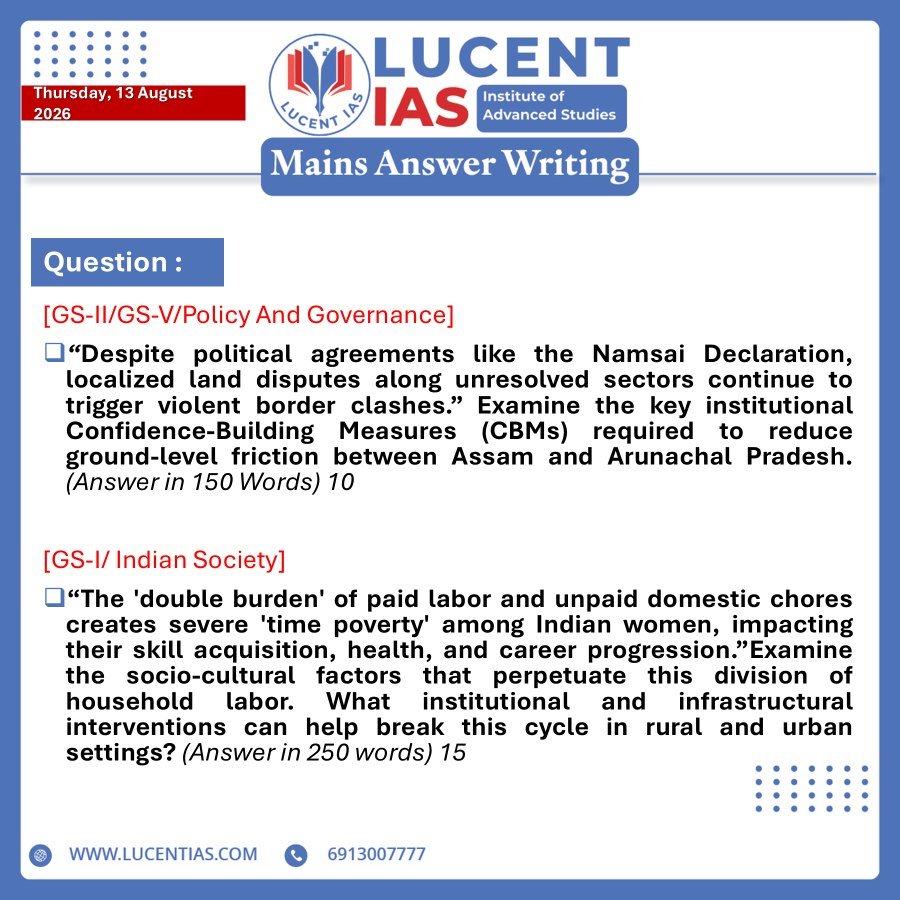
“Despite political agreements like the Namsai Declaration, localized land disputes along unresolved sectors continue to trigger violent border clashes.” Examine the key institutional Confidence-Building Measures (CBMs) required to reduce ground-level friction between Assam and Arunachal Pradesh.
(Answer in 150 words | 10 Marks)
1. Approach
The question uses the directive “Examine”. Therefore, the answer should not merely list CBMs.
A good structure should:
- Establish the progress achieved through the Namsai Declaration and 2023 MoU.
- Identify the implementation gap responsible for continuing local disputes.
- Suggest institutional CBMs under administrative, security, community and developmental dimensions.
- Link the solution with cooperative federalism.
- Conclude by emphasising the transition from political agreement to institutionalised peace.
For a 150-word answer, avoid narrating the entire history of the border dispute.
2. Introduction
Suggested Introduction:
Assam and Arunachal Pradesh share an 804.1-km inter-state boundary. The Namsai Declaration of 2022 and the April 2023 MoU, which amicably resolved 71 of 123 claimed villages, demonstrate the potential of cooperative federalism. Yet recurring local disputes indicate an implementation gap between political settlement and peace on the ground.
This introduction works because it provides:
Fact → Agreement → Achievement → Continuing Challenge
3. Main Body
A. Institutionalise Joint Boundary Management
The existing Regional Committees should evolve into more regular and institutionalised mechanisms for:
- joint field verification;
- cadastral and GIS-based mapping;
- coordination with the Survey of India;
- time-bound identification and demarcation of disputed stretches; and
- periodic reporting to both State Governments.
This would reduce disagreements arising from differing administrative or village-level interpretations of the boundary.
B. Develop a Common Ground-Level SOP
Both States should develop a joint Standard Operating Procedure for unresolved areas.
It should provide that potentially contentious activities such as new construction, settlement expansion or resource extraction in unresolved locations should not be undertaken unilaterally until verification is completed.
The guiding principle should be:
Consultation before alteration of the status quo.
C. Strengthen District-Level Security Coordination
Most violent confrontations begin locally and therefore require mechanisms below the Chief Minister or Chief Secretary level.
Useful interventions include:
- DC-to-DC and SP-to-SP hotlines;
- designated nodal officers;
- joint or coordinated patrolling;
- rapid-response mechanisms; and
- immediate de-escalation protocols when crowds begin assembling.
The response to the August 2026 tensions itself underlined the importance of communication between senior officials of the two States.
D. Establish Border Peace Committees
Local communities must become stakeholders in the peace process.
Border Peace Committees can include:
- Gaon Burahs and traditional institutions;
- village elders;
- women representatives;
- youth organisations;
- civil society representatives; and
- district administration officials.
Such committees can provide early warning, clarify rumours and prevent misinformation from converting minor land disagreements into inter-community confrontation.
Assam already uses Border Outreach Programmes to encourage peaceful coexistence. A Border Festival held at Bhalukpung in January 2023 with counterpart districts of Arunachal Pradesh included cultural and sporting activities, illustrating the potential of people-to-people confidence building.
E. Make Development a Confidence-Building Measure
Border areas should not experience government presence merely through policing.
Jointly coordinated improvement of:
- roads and bridges;
- drinking water;
- schools;
- healthcare;
- telecommunications;
- markets and community infrastructure
can reduce developmental grievances and the competitive assertion of administrative control.
The Assam Government’s inter-state border development framework already covers roads, bridges, drinking-water facilities, school buildings, solar electrification and community infrastructure.
F. Create a Transparent Local Grievance Mechanism
A jointly accessible registry of complaints regarding land use, construction and alleged encroachment can ensure that a dispute enters an institutional channel before becoming a street-level confrontation.
Model Answer – About 150 Words
Assam and Arunachal Pradesh share an 804.1-km inter-state boundary. The 2022 Namsai Declaration and April 2023 MoU, which amicably resolved 71 of 123 claimed villages, demonstrate cooperative federalism. Yet recurring local clashes reveal an implementation gap.
First, Regional Committees should become permanent joint mechanisms for field verification, GIS/cadastral mapping and time-bound demarcation. Second, both States need a common SOP against unilateral construction, settlement or resource extraction in unresolved pockets, maintaining status quo until verification. Third, DC-SP hotlines, joint patrols and rapid-response teams can prevent escalation. Fourth, Border Peace Committees involving Gaon Burahs, traditional leaders, women and youth can counter rumours and build trust. Fifth, jointly planned roads, drinking water, schools, healthcare and markets can reduce competition over state presence. A transparent grievance register and regular public communication should reinforce these measures.
Thus, political agreements must translate into institutionalised, community-backed confidence building on the ground.
Value Addition based on Best Answer Practices
A simple flowchart can significantly improve presentation:
Political Agreement
↓
Joint Verification & Demarcation
↓
Administrative Coordination
↓
Community Dialogue
↓
Rapid De-escalation
↓
Trust
↓
Durable Settlement
4. Similar Questions Asked in UPSC and APSC CCE Mains
There does not appear to be a directly identical previous-year question on institutional CBMs along the Assam–Arunachal boundary. The following are the closest thematic PYQs:
UPSC CSE Mains
UPSC GS-II, 2020:
“How far do you think cooperation, competition and confrontation have shaped the nature of federation in India? Cite some recent examples to validate your answer.”
UPSC GS-II, 2015:
“The concept of cooperative federalism has been increasingly emphasized in recent years. Highlight the drawbacks in the existing structure and the extent to which cooperative federalism would answer the shortcomings.”
APSC CCE Mains
APSC GS-II, 2020:
“Do you think ‘cooperative federalism’ exists in India? Substantiate your answer.”
(150 words, 10 marks)
APSC GS-I, 2020:
“Highlight the factors that led to the rise of regionalism in Indian polity. Critically examine its role in strengthening Indian federalism.”
(250 words, 15 marks)
PYQ Takeaway
The recurring theme is clear:
Federalism is increasingly being examined not merely as a constitutional arrangement but as a practical mechanism for managing diversity, inter-governmental disagreements and regional interests.
For APSC, the Assam–Arunachal dispute provides an excellent Assam-specific application of this broader theme.
Question 2: Double Burden, Unpaid Care Work and Time Poverty Among Indian Women
[GS-I – Indian Society | Women and Social Empowerment]
Question:
“The ‘double burden’ of paid labor and unpaid domestic chores creates severe ‘time poverty’ among Indian women, impacting their skill acquisition, health, and career progression.” Examine the socio-cultural factors that perpetuate this division of household labor. What institutional and infrastructural interventions can help break this cycle in rural and urban settings?
(Answer in 250 words | 15 Marks)
1. Approach
The question has two major demands.
First demand:
Explain why household labour continues to be disproportionately performed by women.
The answer should cover:
Patriarchy + socialisation + care norms + economic invisibility + workplace structures
Second demand:
Suggest differentiated solutions for rural and urban settings.
Therefore, structure the interventions as:
Institutional → Infrastructure → Workplace → Household/Social
An answer that discusses only “women empowerment schemes” would be incomplete because the question specifically concerns time allocation.
2. Introduction
Suggested Introduction:
Time poverty arises when excessive paid and unpaid responsibilities leave individuals with insufficient discretionary time for rest, education, health and social participation. India’s Time Use Survey 2024 demonstrates its gendered character: among participants aged six years and above, women spent 289 minutes daily on unpaid domestic services compared with 88 minutes for men.
This immediately provides:
Concept + Official Data + Gender Dimension
3. Main Body
A. Socio-Cultural Factors Behind the Double Burden
1. Patriarchal Division of Labour
The traditional male breadwinner–female caregiver model continues to associate household work with femininity, even where women participate in paid employment.
Hence, paid employment often gets added to, rather than substituted for, women’s existing domestic responsibilities.
2. Gender Socialisation
Girls are frequently socialised from childhood into cooking, cleaning, sibling care and household assistance, while boys are less consistently expected to perform equivalent care work.
Household labour therefore becomes a learned gender role rather than a biologically determined function.
3. Unequal Care Expectations
Childcare, care of elderly family members and management of illness within the household continue to fall disproportionately on women.
The Time Use Survey itself records a substantial gender gap in caregiving time.
4. Economic Invisibility of Unpaid Work
Because domestic and care work does not ordinarily generate a wage, its economic contribution remains poorly recognised.
As a result, women’s paid employment may be treated as “supplementary”, while domestic duties continue to be regarded as non-negotiable.
5. The “Second Shift”
A woman may complete a full day of paid employment and then undertake cooking, cleaning and caregiving at home.
Thus:
Paid Work + Unpaid Work = Double Burden → Time Poverty
6. Rural–Urban Differences
Rural women may face the combined burden of agricultural work, livestock care, fuel or water collection and household work.
Urban women may face long commuting time, nuclear-family care responsibilities, inadequate affordable childcare and pressure to balance formal employment with domestic expectations.
Consequences of Time Poverty
Time poverty affects women through:
- reduced opportunities for education and reskilling;
- inadequate rest and leisure;
- delayed healthcare and self-care;
- reduced networking and professional development;
- career interruptions;
- lower ability to accept better employment; and
- greater long-term economic dependence.
A useful causal chain is:
Unequal Unpaid Work
↓
Time Poverty
↓
Less Skilling + Poorer Health + Less Rest
↓
Lower Workforce Mobility/Career Progression
↓
Economic Dependence
↓
Reinforcement of Existing Gender Norms
Institutional Interventions
1. Use Time-Use Data in Public Policy
Gender-responsive budgeting should move beyond expenditure on schemes labelled specifically for women and examine whether public infrastructure actually saves women’s time.
Time-use indicators can therefore become useful inputs in planning water, transport, childcare and social-protection programmes.
2. Expand Affordable Childcare
The Palna component of Mission Shakti provides crèche facilities, with most crèches envisaged through Anganwadi centres and provision for standalone facilities where required.
Expansion of such services can simultaneously support:
Early Childhood Care + Women’s Employment + Reduction in Care Burden
3. Make Workplaces Care-Sensitive
Policy should strengthen:
- statutory workplace childcare;
- flexible but secure working arrangements;
- parental leave;
- greater paternal participation in childcare; and
- social security for women in informal employment.
The objective should not be to make women individually “manage” the double burden more efficiently, but to redistribute the burden itself.
Rural Infrastructure Interventions
Time-saving infrastructure can function as gender policy.
Priority interventions include:
- piped drinking water;
- clean cooking energy;
- labour-saving farm technologies;
- mechanisation;
- village-level childcare;
- strengthened Anganwadi-cum-crèche facilities;
- reliable rural transport; and
- accessible healthcare.
Each intervention releases hours that can potentially be redirected towards education, employment, health or leisure.
Urban Infrastructure Interventions
Urban policy should emphasise:
- affordable neighbourhood childcare;
- elder-care facilities;
- safe and dependable public transport;
- childcare close to employment clusters;
- safe rental and working-women accommodation; and
- mixed-use neighbourhoods that reduce excessive commuting time.
Mission Shakti’s Sakhi Niwas framework, for example, seeks to provide safe and conveniently located accommodation for working women.
Social Transformation: Recognise, Reduce and Redistribute
The long-term solution requires changing the household itself.
The principle should be:
Recognise → Reduce → Redistribute
Recognise the social and economic value of unpaid care work.
Reduce avoidable drudgery through public services and technology.
Redistribute domestic and care responsibilities among women, men, families, communities, employers and the State.
Men’s participation in housework and caregiving must therefore be treated as an essential component of gender equality rather than merely “helping” women.
Model Answer – About 250 Words
Time poverty arises when excessive paid and unpaid responsibilities leave individuals with too little discretionary time for rest, learning, health and social participation. India’s Time Use Survey 2024 shows the gendered nature of this burden: among participants aged 6 years and above, women spent 289 minutes daily on unpaid domestic services compared with 88 minutes for men.
The double burden is sustained by patriarchal norms that treat housework as women’s duty; gender socialisation from childhood; unequal expectations regarding childcare and elder-care; economic invisibility of unpaid work; and workplaces built around the “ideal worker” with few care responsibilities. Rural women additionally combine farm work with fuel, water and household tasks, while urban women often face long commutes, nuclear-family care constraints and paid work followed by a “second shift”. This reduces time for skilling, preventive healthcare, rest and professional networking, thereby weakening career continuity and economic independence.
Institutionally, governments should use time-use data in gender-responsive planning, expand Palna and other affordable crèche services, strengthen statutory workplace childcare, social security for informal workers, flexible work, and encourage parental and paternity leave. Infrastructure must also be care-sensitive: piped water, clean cooking energy, mechanisation, transport and Anganwadi-crèches in rural areas; and safe public transport, neighbourhood childcare, elder-care and affordable working-women accommodation in cities.
Finally, behavioural change must make men equal partners in domestic work. The objective should be to recognise, reduce and redistribute unpaid care work.
Gender equality therefore requires not only women’s access to paid employment, but genuine time autonomy.
Data Source: Time Use Survey 2024, Ministry of Statistics and Programme Implementation.
4. Similar Questions Asked in UPSC and APSC CCE Mains
Again, these are closest thematic PYQs, rather than identical questions on “time poverty”.
UPSC CSE Mains
UPSC GS-I, 2024:
“Distinguish between gender equality, gender equity and women’s empowerment. Why is it important to take gender concerns into account in programme design and implementation?”
This PYQ is particularly important because it links women’s empowerment with the design of public policy, precisely the perspective required for reducing time poverty.
UPSC GS-II, 2025:
“Women’s social capital complements in advancing empowerment and gender equity. Explain.”
(150 words)
APSC CCE Mains
APSC GS-I, 2020:
“Write a note on the feminization of labour in India.”
(150 words, 10 marks)
APSC GS-V, 2020:
“Discuss the steps taken by the Government of Assam in the realm of gender equality in recent years.”
(150 words, 10 marks)
Frequently Asked Questions
What is the Namsai Declaration?
The Namsai Declaration was signed by Assam and Arunachal Pradesh on 15 July 2022 as part of their effort to resolve the longstanding inter-state boundary dispute through bilateral negotiations and Regional Committees.
How many villages were resolved under the Assam–Arunachal agreement?
The Government of Assam states that the April 2023 MoU amicably resolved 71 of the 123 villages under consideration, with timelines provided for further boundary finalisation.
What is time poverty?
Time poverty refers to a situation where excessive paid and unpaid responsibilities leave an individual with inadequate discretionary time for activities such as education, health, rest, leisure or skill development.
What does the Time Use Survey 2024 reveal about unpaid domestic work?
Among participants aged six years and above, women spent 289 minutes per day on unpaid domestic services, compared with 88 minutes for men, demonstrating the continuing gender imbalance in domestic labour.
About Lucent IAS
Lucent IAS is a premier coaching institute in Guwahati, dedicated to empowering APSC aspirants with a result-oriented approach. Recognized as a top destination for APSC Coaching, we offer comprehensive guidance ranging from Foundation Courses and Advanced Mains preparation to our signature Assam-Centric study modules. With expert faculty, small batch sizes for personalized mentoring, and the acclaimed Saadhana Test Series, Lucent IAS is committed to helping you crack the Civil Services Examination.
Publications From LUCENT IAS
- “The Assam Odyssey: The Complete Assam Centric Resource useful for APSC CCE and various other Departmental Examinations. Read More
- InExam PYQ Explained.Read More
- Mains Tattva: The Craft of Answer Writing (GS Paper PYQs). Read More
- Maanchitra – An Illustrative Colour-Coded Informative Map of Assam. Read More
- প্ৰাৰম্ভ (Prarambha). Read More
- অসম ওডিচী – The Assam Odyssey (Assamese Edition). Read More
Connect with us on Social Media:
- Website: LUCENT IAS
- Study Portal/Course Access: STUDY.LUCENTIAS
- YouTube: @LUCENTIAS
- Instagram: @LUCENT_IAS
- Facebook: @LUCENTIAS
- Official Telegram Channel: @LucentIAS
- Telegram Public Forum: @LUCENTIAS
Start your journey to success today. Visit us at lucentias.com or call +91-6913007777 for more details.