


Constitutional Safeguards on Arrest & India’s Integration into Global Value Chains. Practice APSC Mains answer writing on constitutional safeguards against arbitrary arrest and India’s global value chains, with Assam examples, approach and PYQs.
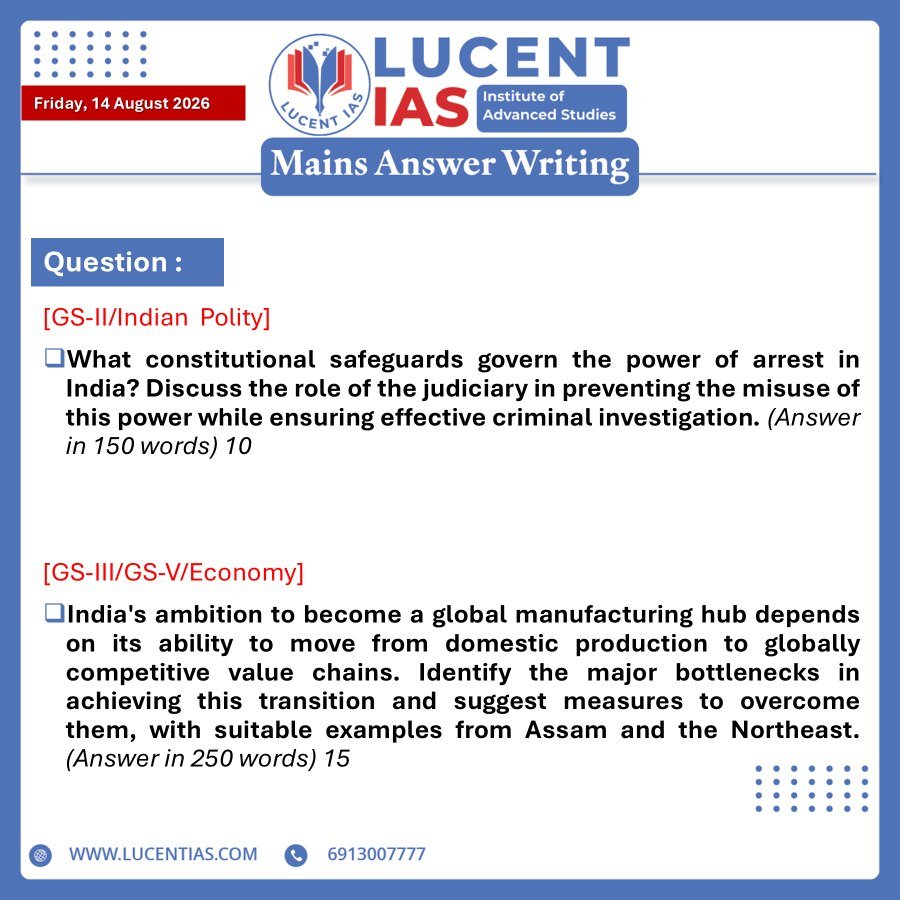
Question 1: Constitutional Safeguards Governing Arrest in India
GS-II | Indian Polity
Question:
What constitutional safeguards govern the power of arrest in India? Discuss the role of the judiciary in preventing the misuse of this power while ensuring effective criminal investigation.
150 words | 10 Marks
Approach
The question has two clear parts. First, identify the constitutional and legal safeguards surrounding arrest. Second, explain how courts have tried to prevent arbitrary arrest without denying investigating agencies the power to arrest where custody is genuinely necessary.
The core idea of the answer should therefore be:
Personal Liberty ← Rule of Law → Effective Investigation
Avoid turning the answer into a mere list of Supreme Court cases. Use judgments to establish principles.
Introduction
Arrest is one of the most coercive powers available to the State because it directly restricts an individual’s liberty. The Constitution therefore does not prohibit arrest, but requires that deprivation of liberty follow a lawful, fair and reasonable procedure, particularly under Articles 21 and 22.
Main Body
Constitutional and Legal Safeguards
Article 21 protects life and personal liberty and requires deprivation of liberty to take place according to law.
Article 22(1) gives an arrested person the right to be informed of the grounds of arrest and to consult and be defended by a legal practitioner.
Article 22(2) requires production before the nearest Magistrate within 24 hours, excluding journey time.
Article 20(3) protects an accused against compelled self-incrimination.
These constitutional guarantees are supplemented by the Bharatiya Nagarik Suraksha Sanhita, 2023. Its arrest provisions regulate when police may arrest without warrant and provide safeguards relating to procedure of arrest, access to an advocate, communication of grounds, information to relatives or friends, health and safety, and production before the appropriate authority.
How Has the Judiciary Controlled Misuse?
The judiciary has gradually developed a simple but important principle:
The existence of a power to arrest does not mean that arrest must automatically follow.
In Joginder Kumar v. State of U.P., the Supreme Court emphasised the need to justify arrest rather than treating it as routine.
In D.K. Basu v. State of West Bengal, the Court laid down safeguards relating to arrest records, identification of police personnel, medical examination and information to relatives, among others.
In Arnesh Kumar v. State of Bihar, the Court cautioned against automatic arrest and strengthened scrutiny of the necessity for arrest, particularly in offences carrying punishment up to seven years.
The larger judicial approach is therefore not anti-investigation. Rather, it distinguishes between necessary custody and unnecessary incarceration.
Where an accused may abscond, destroy evidence, intimidate witnesses or obstruct investigation, arrest may be justified. Where these concerns do not exist, investigation should not depend automatically on custodial detention.
Model Answer
Arrest is a coercive State power that directly affects personal liberty. Hence, Articles 21 and 22 subject it to constitutional safeguards. Article 21 requires a fair, just and lawful procedure, while Article 22 guarantees communication of grounds of arrest, access to legal counsel and production before a Magistrate within 24 hours. Article 20(3) protects against compelled self-incrimination. The BNSS, 2023 further regulates the necessity and procedure of arrest.
The judiciary has strengthened these protections. In Joginder Kumar, the Supreme Court distinguished the power to arrest from the necessity to arrest. D.K. Basu prescribed procedural safeguards against custodial abuse, while Arnesh Kumardiscouraged automatic arrests. Judicial scrutiny at the remand stage further ensures that detention is legally justified.
However, liberty cannot disable legitimate investigation. Arrest remains necessary where there is risk of absconding, evidence tampering or witness intimidation.
Thus, constitutionalism requires liberty with lawful investigation—arrest should serve investigation, not substitute for it.
A Simple Presentation Idea
You may draw this small balance in the examination:
Individual Liberty
↕
Judicial & Procedural Safeguards
↕
Effective Criminal Investigation
This directly addresses the second half of the question.
Related UPSC Mains Questions
A closely related UPSC GS-II 2023 question asked candidates to explain the Constitution as a living instrument with special reference to the expanding horizons of the right to life and personal liberty.
In UPSC GS-II 2024, the examination again returned to Article 21 through a question on the right to privacy as intrinsic to life and personal liberty, along with DNA testing and paternity.
Question 2: India, Manufacturing and Global Value Chains
GS-III / GS-V | Indian Economy & Assam Economy
Question:
India’s ambition to become a global manufacturing hub depends on its ability to move from domestic production to globally competitive value chains. Identify the major bottlenecks in achieving this transition and suggest measures to overcome them, with suitable examples from Assam and the Northeast.
250 words | 15 Marks
Approach
The important phrase in the question is “move from domestic production to globally competitive value chains.” Therefore, simply writing about increasing manufacturing output will not be enough. The answer should explain why Indian firms need to become part of networks connecting:
Inputs → Components → Manufacturing → Logistics → Global Markets
Then identify the barriers and bring Assam and the Northeast naturally into the solution.
Introduction
India’s manufacturing challenge is gradually shifting from “Make in India” to “Make for the World.” The Economic Survey 2025-26 notes India’s growing integration with global trade and identifies electronics, automobiles, pharmaceuticals and electrical machinery among important drivers of merchandise export growth.
The next step is to deepen India’s participation in global production networks rather than remain concentrated in final assembly or the domestic market.
Main Body
What Holds India Back?
High logistics and transaction costs make Indian products less competitive. This becomes particularly important for the Northeast because distance, terrain and connectivity gaps increase the cost of moving inputs and finished products.
Weak domestic supplier networks mean manufacturers often depend heavily on imported components or capital goods. A factory alone does not create a value chain; it needs hundreds of capable suppliers around it.
MSME constraints are another critical gap. Smaller firms often struggle with finance, technology, quality certification and the scale required to supply large domestic or global manufacturers.
Skill and technology gaps restrict movement into higher-value manufacturing. Advanced electronics, semiconductor packaging, precision manufacturing and Industry 4.0 require a workforce with specialised skills.
Finally, regulatory uncertainty and inefficient trade procedures can weaken export competitiveness. Firms participating in global supply chains need predictability because production is often spread across several countries.
What Should India Do?
The focus should move from attracting individual factories to building manufacturing ecosystems.
Industrial clusters should connect anchor companies with component suppliers, MSMEs, logistics providers and training institutions.
Multimodal connectivity through highways, railways, ports and waterways can reduce logistics costs.
MSMEs need easier technology adoption, quality certification, credit and stronger links with larger exporters.
Skill programmes must increasingly be designed with industry rather than independently of it.
Trade policy should also facilitate competitive access to essential intermediate goods while encouraging higher domestic value addition.
Assam and the Northeast: From Periphery to Value Chain
The strongest contemporary example is the Tata Electronics semiconductor assembly and testing facility at Jagiroad, being developed with an investment outlay of around ₹27,000 crore and intended to serve global customers.
The development becomes even more significant from a GVC perspective after the 2026 Tata Electronics–Qualcomm partnership. Qualcomm Automotive Modules are planned to be manufactured at the Jagiroad facility for Indian and global automobile manufacturers. Assam is therefore not merely hosting a factory; it has the opportunity to become part of an international electronics and automotive supply chain.
Connectivity will determine whether such opportunities spread beyond individual projects. National Waterway-2 on the Brahmaputra, extending from Dhubri to Sadiya, handled about 1.29 million metric tonnes of cargo in 2025-26, illustrating the growing potential of waterways within the region’s multimodal logistics network.
The State has also created a supporting policy base through measures such as the Assam Electronics (Semiconductor etc.) Policy 2023 and Assam Logistics & Warehousing Policy 2025.
The opportunity is therefore clear: the Northeast’s future manufacturing strategy should connect investment, local suppliers, skills and connectivity, rather than viewing each project in isolation.
Model Answer
India’s manufacturing ambition requires a shift from simply producing domestically to becoming an integral part of Global Value Chains (GVCs), where production, components and markets are internationally connected.
Several bottlenecks constrain this transition. High logistics costs and fragmented multimodal connectivity reduce competitiveness. Weak domestic component ecosystems increase dependence on imports, while MSMEs face credit, technology, scale and quality-certification constraints. Skill shortages and low adoption of advanced manufacturing technologies limit movement into higher-value activities. Regulatory uncertainty and inefficient trade procedures can further discourage export-oriented investment.
India should therefore develop integrated industrial clusters around anchor firms, strengthen domestic supplier networks and connect MSMEs with large manufacturers. Better rail, road, port and inland-waterway connectivity can reduce logistics costs. Industry-linked skilling, R&D, technology transfer and easier quality certification should complement stable and predictable trade policies.
Assam demonstrates the possibilities of this approach. Tata Electronics’ Jagiroad semiconductor assembly and testing facility can connect the State with global electronics supply chains. Its partnership with Qualcomm for automotive modules strengthens this potential. National Waterway-2 and improving multimodal infrastructure can support lower-cost movement of goods across the Northeast.
India must therefore move from factory-led manufacturing to ecosystem-led, export-oriented manufacturing. For Assam, connectivity, skills and local supplier development can turn geographical location into an Act East advantage
Related UPSC Mains Question
UPSC GS-III 2023 asked:
“Faster economic growth requires increased share of the manufacturing sector in GDP, particularly of MSMEs. Comment on the present policies of the Government in this regard.”
The 2023 PYQ is particularly useful because it establishes the continuing importance of manufacturing + MSMEs as a Mains theme. The present question takes that theme one step further by connecting manufacturing with Global Value Chains and regional examples from Assam and the Northeast.
Answer-Writing Takeaways from Today’s Questions
- For the arrest question, avoid writing only constitutional Articles and case names. The examiner is asking whether you understand the balance between State power and individual liberty.
- For the manufacturing question, avoid turning the answer into a catalogue of schemes. The real issue is whether India can create an ecosystem in which Indian companies and MSMEs become reliable suppliers within international production networks.
- And when an APSC question specifically asks for Assam or Northeast examples, do not add them as an afterthought. Integrate them into the argument itself.
Remember the two core frameworks:
Arrest:
Power → Safeguards → Judicial Scrutiny → Necessary Investigation
Manufacturing:
Investment → Suppliers → Skills → Logistics → Exports → Global Value Chains
That is the difference between merely knowing a topic and writing a Mains-ready answer.
About Lucent IAS
Lucent IAS is a premier coaching institute in Guwahati, dedicated to empowering APSC aspirants with a result-oriented approach. Recognized as a top destination for APSC Coaching, we offer comprehensive guidance ranging from Foundation Courses and Advanced Mains preparation to our signature Assam-Centric study modules. With expert faculty, small batch sizes for personalized mentoring, and the acclaimed Saadhana Test Series, Lucent IAS is committed to helping you crack the Civil Services Examination.
Publications From LUCENT IAS
- “The Assam Odyssey: The Complete Assam Centric Resource useful for APSC CCE and various other Departmental Examinations. Read More
- InExam PYQ Explained.Read More
- Mains Tattva: The Craft of Answer Writing (GS Paper PYQs). Read More
- Maanchitra – An Illustrative Colour-Coded Informative Map of Assam. Read More
- প্ৰাৰম্ভ (Prarambha). Read More
- অসম ওডিচী – The Assam Odyssey (Assamese Edition). Read More
Connect with us on Social Media:
- Website: LUCENT IAS
- Study Portal/Course Access: STUDY.LUCENTIAS
- YouTube: @LUCENTIAS
- Instagram: @LUCENT_IAS
- Facebook: @LUCENTIAS
- Official Telegram Channel: @LucentIAS
- Telegram Public Forum: @LUCENTIAS
Start your journey to success today. Visit us at lucentias.com or call +91-6913007777 for more details.