

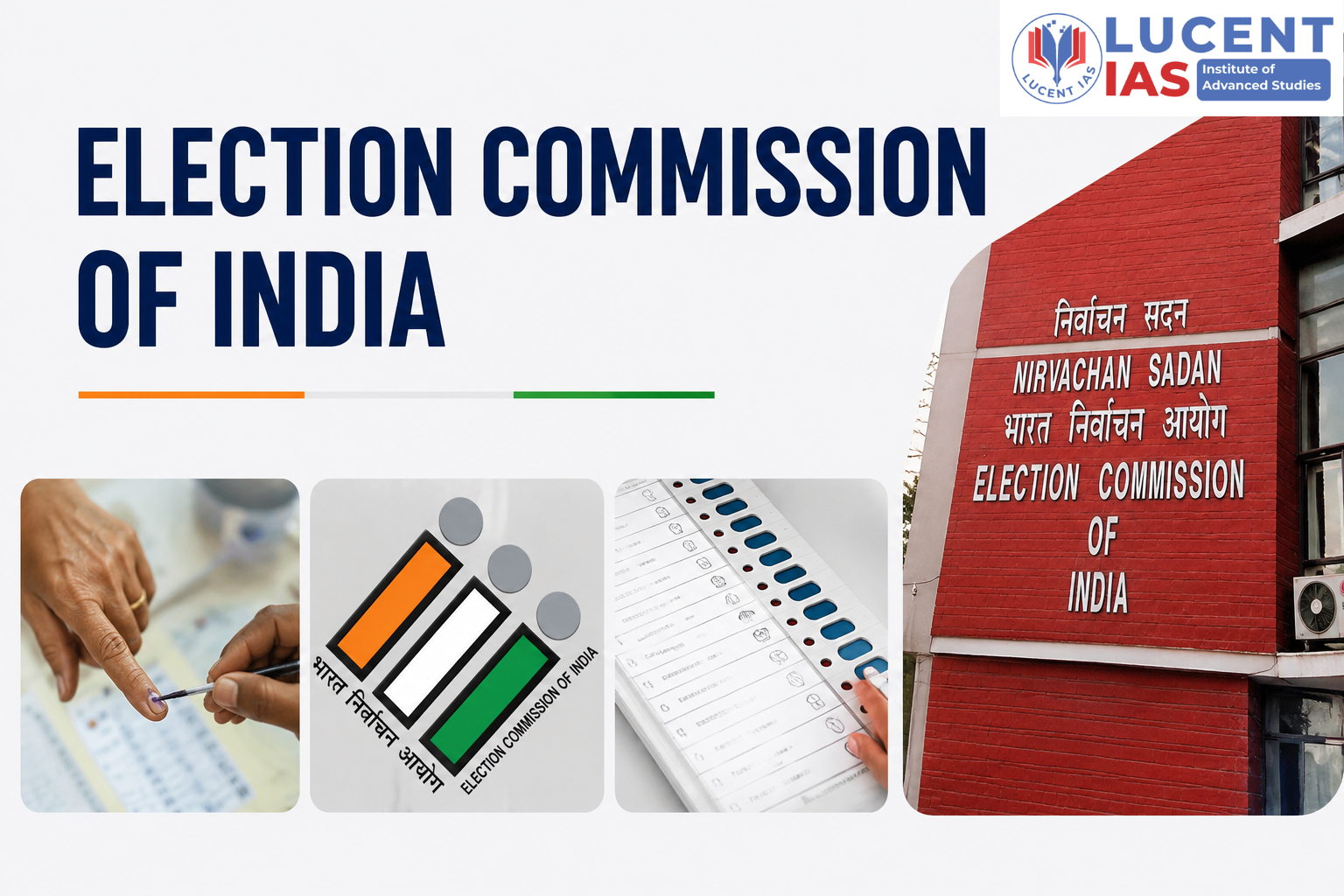
Understand the constitutional provisions related to the Election Commission of India, appointment and removal of the Chief Election Commissioner (CEC), safeguards for independence, and the removal process important for UPSC and APSC ( Prelims & Mains ).
Election Commission of India (ECI)
The Election Commission of India is a permanent and independent constitutional body established to ensure free and fair elections in India.
Constitutional Basis
- Established under Article 324 of the Constitution.
- Vests the superintendence, direction and control of elections in the Election Commission.
- Conducts elections for:
- Parliament
- State Legislatures
- Office of the President
- Office of the Vice-President
- Elections to Panchayats and Municipalities are conducted by the State Election Commission (SEC).
Establishment and Composition
- Established on: 25 January 1950
- Composition: Strength of ECI is not specified in the Constitution, it is at the discretion of the President. Currently, there are 3 Members : Chief Election Commissioner (CEC) and Two Election Commissioners.
Appointment and Tenure
Appointment
- Appointed by the President of India.
Qualifications
The Constitution does not prescribe any specific qualifications for the appointment of Election Commissioners, senior civil servants holding the rank of Cabinet Secretary or equivalent are conventionally appointed to these posts.
Tenure
- Six years or until attaining the age of 65 years, whichever is earlier.
Appointment Process under the CEC and Other Election Commissioners Act, 2023
The Bill replaces the Election Commission (Conditions of Service of Election Commissioners and Transaction of Business) Act, 1991.
Selection Committee
The Chief Election Commissioner (CEC) and Election Commissioners (ECs) are appointed by the President on the recommendation of a Selection Committee comprising:
- The Prime Minister as Chairperson,
- The Leader of Opposition in the Lok Sabha (or the leader of the largest opposition party), and
- A Union Cabinet Minister nominated by the Prime Minister.
Search Committee
A Search Committee headed by the Union Law Minister, along with two members not below the rank of Secretary to the Government of India, prepares a shortlist of five eligible candidates for consideration.
Additional Provision
Under Section 8 of the Act, the Selection Committee is empowered to consider candidates beyond the shortlisted five names recommended by the Search Committee.
Removal Process of the Chief Election Commissioner (CEC)
Constitutional Basis
- Under Article 324(5), the CEC can be removed only in the same manner and on the same grounds as a Judge of the Supreme Court.
Grounds for Removal
The CEC may be removed only for:
- Proven misbehaviour, or
- Incapacity.
Procedure for Removal
1. Notice of Motion
- A removal motion can be initiated in Parliament by:
- At least 100 members of the Lok Sabha, or
- At least 50 members of the Rajya Sabha.
2. Admission of Motion
- The Speaker of the Lok Sabha or the Chairman of the Rajya Sabha may either accept or reject the motion.
3. Constitution of Inquiry Committee
- If the motion is admitted, a three-member inquiry committee is formed consisting of:
- A Supreme Court Judge,
- A Chief Justice of a High Court, and
- A distinguished jurist.
4. Investigation
- The committee examines the allegations and submits its findings regarding misbehaviour or incapacity.
5. Approval by Parliament
- If the charges are established, both Houses of Parliament must pass the motion with:
- A majority of the total membership of the House, and
- A two-thirds majority of members present and voting.
6. Order of Removal
- After parliamentary approval, the resolution is sent to the President, who formally removes the CEC from office.
Removal of Other Election Commissioners
- Election Commissioners other than the CEC can be removed only on the recommendation of the Chief Election Commissioner.
Powers and Functions of the Election Commission of India (ECI)
The powers and functions of the Election Commission can be grouped into three categories:
- Administrative
- Advisory
- Quasi-Judicial
Major Powers and Functions
- Conducts elections to:
- Parliament
- State Legislatures
- President and Vice-President
- Delimits constituencies based on the Delimitation Act.
- Prepares and revises electoral rolls and registers eligible voters.
- Announces election schedules and scrutinises nomination papers.
- Recognises political parties and allots election symbols.
- Acts as a quasi-judicial body in disputes related to party recognition and symbols.
- Enforces the Model Code of Conduct during elections.
- Cancels or countermands polls in cases of rigging, violence or malpractice.
- Advises:
- President on disqualification of MPs.
- Governor on disqualification of MLAs/MLCs.
- Registers political parties and grants national/state party status.
- Supervises the entire election machinery to ensure free and fair elections.
- Requests staff and administrative support from the Union and State Governments for conducting elections.
- Allocates broadcast and telecast time to political parties on radio and television during elections.
- Advises the President regarding extension of President’s Rule in a state after one year, if elections cannot be conducted.
- Registers political parties and grants them recognition as National or State Parties based on their electoral performance.
Important Facts
- ECs enjoy:
- Equal powers
- Equal salary and status similar to that of a Supreme Court Judge.
- Initially, the Commission functioned as a single-member body.
- Two Election Commissioners were first appointed in:
- October 1989
- Posts were abolished in:
- January 1990
- Reintroduced in:
- October 1993. Since then and till today the Election Commission has been functioning as a multi member body consisting of three election commissioners.
UPSC CSE Prelims Previous Year Question
Q. Consider the following statements: (UPSC CSE 2017)
1. The Election Commission of India is a five-member body.
2. Union Ministry of Home Affairs decides the election schedule for the conduct of both general elections and bye-elections.
3. Election Commission resolves the disputes relating to splits/mergers of recognised political parties.
Which of the statements given above is/are correct?
a) 1 and 2 only
b) 2 only
c) 2 and 3 only
d) 3 only
Correct Answer: D
Explained:
Statement 1 is incorrect
- The Election Commission of India is not a five-member body.
- Strength of ECI is not specified in the Constitution, it is at the discretion of the President. Currently, there are 3 Members:
- One Chief Election Commissioner (CEC)
- Two Election Commissioners (ECs)
Statement 2 is incorrect
- The Election Commission of India, not the Union Ministry of Home Affairs, decides the election schedule for general elections and bye-elections.
Statement 3 is correct
The Election Commission has the power to decide disputes related to:
- Splits in political parties
- Mergers of recognised political parties
- Allocation of election symbols
Q. Consider the following statements: (UPSC CSE 2012)
i) Union Territories are not represented in the Rajya Sabha.
ii) It is within the purview of the Chief Election Commissioner to adjudicate the election disputes.
iii) According to the Constitution of India, the Parliament consists of the Lok Sabha and the Rajya Sabha only.
Which of the statements given above is/are correct?
(a) 1 only (b) 2 and 3
(c) 1 and 3 (d) None of these
Correct Answer: D
Explained:
- Statement 1 Incorrect: Some Union Territories like Delhi and Puducherry have Rajya Sabha representation.
- Statement 2 Incorrect: Election disputes are decided by the Supreme Court/High Courts, not by the Chief Election Commissioner.
- Statement 3 Incorrect: Parliament consists of the President, Lok Sabha and Rajya Sabha.
About Lucent IAS
Lucent IAS is a premier coaching institute in Guwahati, dedicated to empowering APSC aspirants with a result-oriented approach. Recognized as a top destination for APSC Coaching, we offer comprehensive guidance ranging from Foundation Courses and Advanced Mains preparation to our signature Assam-Centric study modules. With expert faculty, small batch sizes for personalized mentoring, and the acclaimed Saadhana Test Series, Lucent IAS is committed to helping you crack the Civil Services Examination.
Publications From LUCENT IAS
- “The Assam Odyssey: The Complete Assam Centric Resource useful for APSC CCE and various other Departmental Examinations. Read More
- InExam PYQ Explained.Read More
- Mains Tattva: The Craft of Answer Writing (GS Paper PYQs). Read More
- Maanchitra – An Illustrative Colour-Coded Informative Map of Assam. Read More
- প্ৰাৰম্ভ (Prarambha). Read More
- অসম ওডিচী – The Assam Odyssey (Assamese Edition). Read More
Start your journey to success today. Visit us at lucentias.com or call +91-6913007777 for more details.