

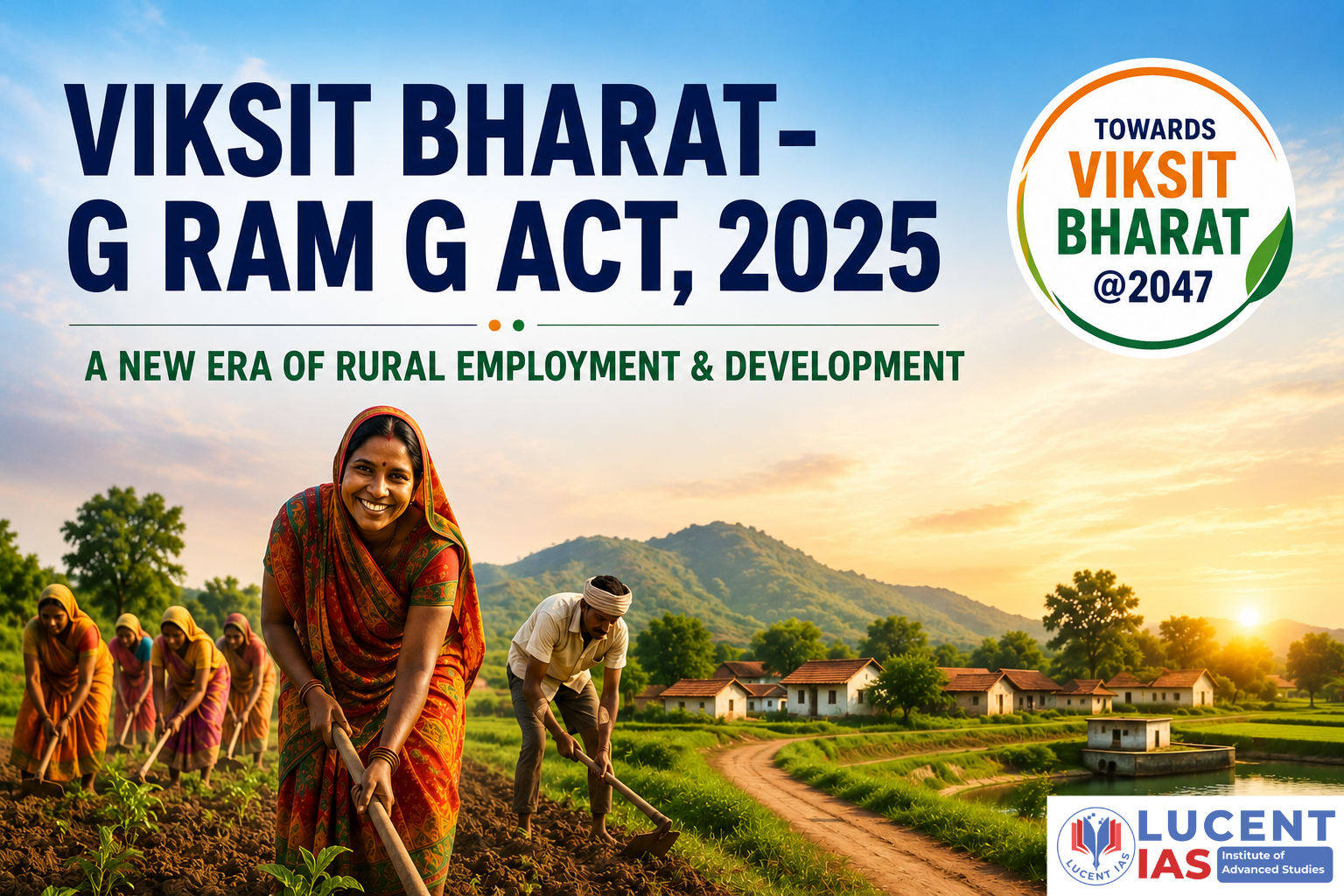
Learn about the Viksit Bharat–G RAM G Act, 2025, its key features, employment guarantee, funding pattern, VGPP, and how it replaces MGNREGA from July 1, 2026. Important for APSC & UPSC (Prelims & Mains).
Blog Source: PIB
Viksit Bharat–G RAM G Act, 2025
The Viksit Bharat – Guarantee for Rozgar and Ajeevika Mission (Gramin) [VB–G RAM G] Act, 2025 is a landmark rural employment and development legislation introduced by the Government of India to align rural transformation with the vision of Viksit Bharat @2047.
The Act replaces the Mahatma Gandhi National Rural Employment Guarantee Act (MGNREGA) and expands the employment guarantee framework while focusing on sustainable rural infrastructure, convergence-based planning, and climate resilience.
Key Highlights of the Act
| Feature | Details |
|---|---|
| Act Name | Viksit Bharat–G RAM G Act, 2025 |
| Full Form | Viksit Bharat – Guarantee for Rozgar and Ajeevika Mission (Gramin) |
| Effective Date | 1 July 2026 |
| Replaces | Mahatma Gandhi NREGA |
| Employment Guarantee | 125 days per financial year |
| Target Group | Rural households willing to undertake unskilled manual work |
| Nature | Rights-based statutory employment guarantee |
Transition from MGNREGA to VB–G RAM G
Continuity of Employment
The government has clarified that:
- Employment under MGNREGA will continue uninterrupted till July 2026
- Adequate labour budgets have been allocated
Existing Job Cards
Current MGNREGA Job Cards will remain valid:
- Till new Gramin Rozgar Guarantee Cards are issued
- Subject to completion of e-KYC
Wage Payment and Compensation
Wage Payments
- Wages will be paid weekly or within a fortnight
- Payment through Direct Benefit Transfer (DBT)
- Deposited into bank or post office accounts
Delay Compensation
If wages are delayed beyond 15 days after muster roll closure:
- Workers receive compensation
- At the rate of 0.05% per day of unpaid wages
Transparency and Accountability Measures
Janata Board at Worksites
Every worksite must display:
- Work details
- Estimated labour days
- Material costs
- Project information
Weekly Public Disclosure
Both digital and physical disclosures will include:
- Muster rolls
- Payments
- Work sanctions
- Progress reports
Use of Contractors and Machinery
The Act prohibits:
- Contractors
- Labour-displacing machinery
Manual labour remains the core principle of the scheme.
Attendance System
Attendance will be captured through:
- Face authentication-based attendance system
Exception handling provisions exist for:
- Poor connectivity
- Technical failures
- Device issues
Application for Employment
Workers may demand employment through:
- Gram Panchayat
- Programme Officer
- Digital platforms
- Written or oral application
Employment must be provided within 15 days of application.
Unemployment Allowance
If employment is not provided within 15 days:
- State Government must pay unemployment allowance
- At least:
- One-fourth of wage rate for first 30 days
- One-half thereafter
Types of Works Permitted
The Act allows works under four thematic categories:
1. Water Security Works
2. Core Rural Infrastructure
3. Livelihood-related Infrastructure
4. Extreme Weather Mitigation Works
Convergence with Other Schemes
The Act promotes a “single-plan, multi-funding” approach.
Convergence can occur with:
- Central schemes
- State schemes
- Local body initiatives
PMAY-G Support
PMAY-G housing works can receive:
- 90/95 person-days wage support
under the Act.
What is VGPP?
The Viksit Gram Panchayat Plan (VGPP) is a participatory, convergence-based local development plan aligned with Viksit Bharat @2047.
All works under the Act must originate from VGPPs approved by the Gram Sabha.
Importance of VGPP
VGPP ensures:
- Need-based planning
- Saturation-focused development
- Community participation
- Convergence of schemes
- Future-ready rural infrastructure
Role of Gram Panchayats
Gram Panchayats play a central role in implementation by:
- Registering households
- Issuing employment demand receipts
- Executing works
- Maintaining records
- Preparing VGPPs
- Conducting public disclosure meetings
Worksite Facilities
Mandatory facilities include:
- Safe drinking water
- Shade for workers and children
- Rest areas
- First aid box
Funding Pattern Under the Act
| Category | Centre : State Share |
|---|---|
| North Eastern & Himalayan States | 90 : 10 |
| Other States/UTs with Legislature | 60 : 40 |
| UTs without Legislature | 100% Central Funding |
Peak Agricultural Season Provision
To avoid labour shortages during sowing and harvesting seasons:
- State Governments may temporarily suspend works during peak agricultural periods.
Relaxations During Natural Calamities
The Central Government may provide:
- Additional employment days
- Expanded permissible works
- Relaxed documentation norms
During:
- Floods
- Droughts
- Cyclones
- Other extraordinary situations
Material Expenditure Limit
Material component expenditure:
- Cannot exceed 40% at district level
This ensures labour-intensive implementation.
Work Beyond 5 Kilometers
As far as possible, employment will be provided within a radius of 5 kilometers of the applicant’s village. If provided beyond that (but within the Block), workers are paid an extra 10% of the wage rate for transport and living expenses.
District-Level Implementation
- The District Collector or equivalent officer designated by the State Government shall function as the District Programme Coordinator (DPC).
- An officer not below the rank of Block Development Officer shall be appointed as Programme Officer at block level.
APSC/ UPSC Prelims Practice Question
Q. Consider the following statements regarding the Viksit Bharat–G RAM G Act, 2025:
- The Act guarantees 125 days of wage employment to rural households.
- Contractors are allowed for execution of works under the Act.
- The Act replaces Mahatma Gandhi NREGA from 1 July 2026.
Which of the statements given above are correct?
A. 1 and 2 only
B. 1 and 3 only
C. 2 and 3 only
D. 1, 2 and 3
Correct Answer: B
Explained: Statement 2 is wrong because, Contractors are not allowed for execution of works under the Act.
APSC & UPSC Mains Practice Question
Mains Question
Q. Discuss how the Viksit Bharat–G RAM G Act, 2025 seeks to strengthen rural livelihoods, decentralized planning, and climate-resilient infrastructure in India. Also examine its key differences from MGNREGA. (Write in 250 words) 15
About Lucent IAS
Lucent IAS is a premier coaching institute in Guwahati, dedicated to empowering APSC aspirants with a result-oriented approach. Recognized as a top destination for APSC Coaching, we offer comprehensive guidance ranging from Foundation Courses and Advanced Mains preparation to our signature Assam-Centric study modules. With expert faculty, small batch sizes for personalized mentoring, and the acclaimed Saadhana Test Series, Lucent IAS is committed to helping you crack the Civil Services Examination.
Publications From LUCENT IAS
- “The Assam Odyssey: The Complete Assam Centric Resource useful for APSC CCE and various other Departmental Examinations. Read More
- InExam PYQ Explained.Read More
- Mains Tattva: The Craft of Answer Writing (GS Paper PYQs). Read More
- Maanchitra – An Illustrative Colour-Coded Informative Map of Assam. Read More
- প্ৰাৰম্ভ (Prarambha). Read More
- অসম ওডিচী – The Assam Odyssey (Assamese Edition). Read More
Start your journey to success today. Visit us at lucentias.com or call +91-6913007777 for more details.