

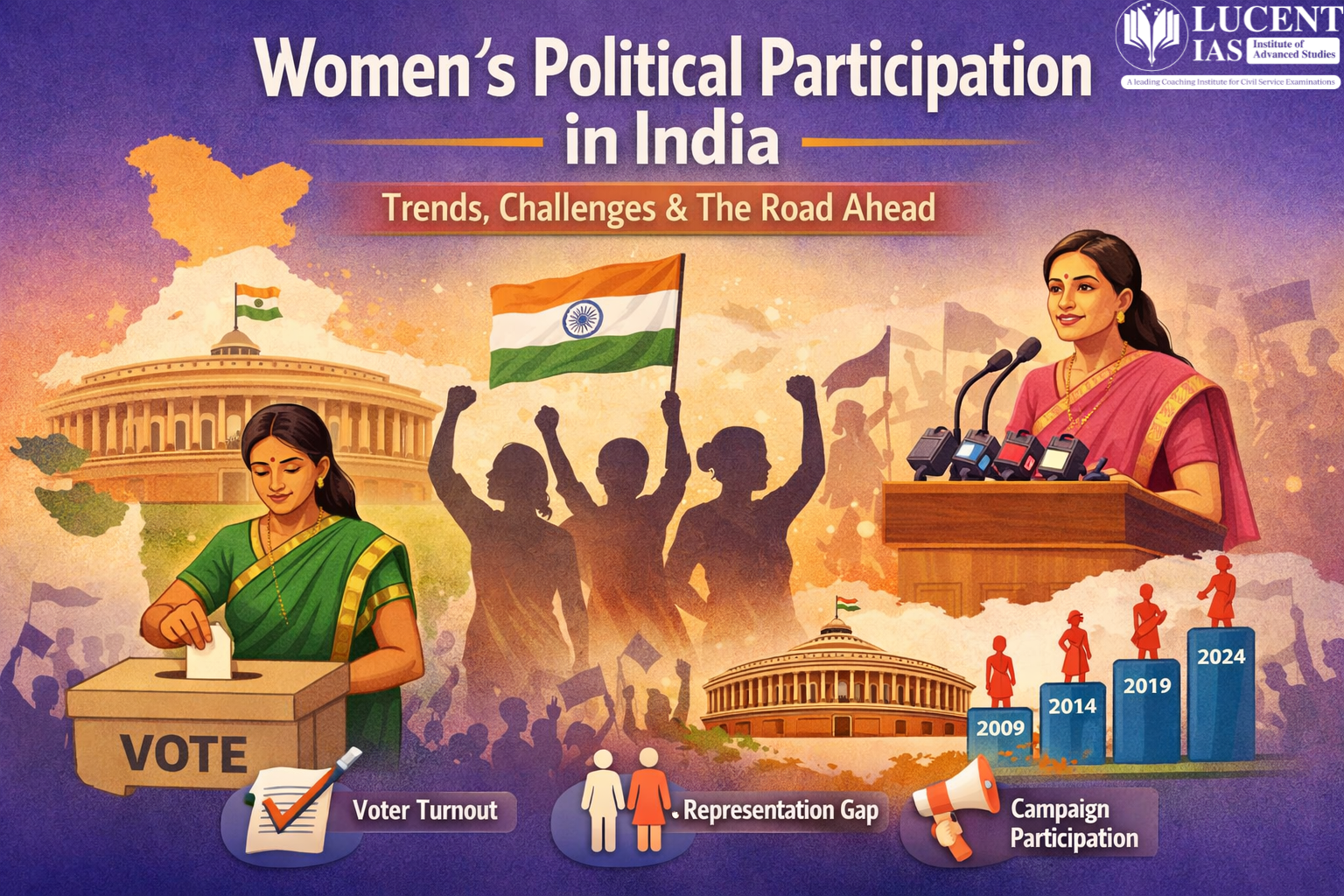
Women’s political participation in India has improved significantly in voter turnout, yet representation in legislatures and campaign-level engagement remains limited. Here is an in-depth analysis of women’s political participation in India, covering voter turnout trends, campaign involvement, parliamentary representation, structural barriers, and the implications of the Women’s Reservation Bill. Read More Below.
Overview of Women as Voters
- Post-Independence Scenario: In the initial decades after independence, electoral participation in India showed a clear gender disparity. Although women were granted the right to vote from the beginning of the Republic, their turnout remained significantly lower than that of men due to social and structural constraints.
- Widening Gap in the 1970s: The gender difference in voter turnout became particularly pronounced in the 1970s, when the gap widened to 11.8 percentage points.
- Gradual Improvement from the 1980s: From the 1980s onward, this gap began to gradually decline as women’s awareness, mobility, and political engagement increased.
- Recent Electoral Trends (2014–2024): By 2014, the gender gap in turnout had reduced to 1.5 percentage points, and in the 2019 and 2024 Lok Sabha elections, women voted at almost the same rate as men.
- State Assembly Elections (1990–2025): In state elections during the 1990s and early 2000s, women’s turnout was typically 4–5 percentage points lower than that of men. However, the gap steadily narrowed through the 2000s, reaching –1.8 percentage points during the 2005–07 elections and –1 percentage point during 2008–10.
- Turnout Reversal after 2011: A notable shift occurred after 2011, when women began voting in greater numbers than men. The turnout gap turned positive at 1.13 percentage points during 2011–13, widened to 2.82 percentage points during 2015–16, and remained positive at 1.6 percentage points during 2020–25.
Electoral Participation beyond Voting
Campaign-Level Participation: Although women’s voter turnout has nearly reached parity with men, their participation in campaign-related activities still reflects a noticeable gender gap.
Women’s Participation in Campaign Activities (2009–2024):
- Election meetings and rallies: Participation increased from 9% in 2009 to 31% in 2024.
- Political processions: Participation rose from 5% in 2009 to 18% in 2024.
- Door-to-door canvassing: Participation grew from 6% in 2009 to 19% in 2024.
Overall Trend: These patterns indicate that women are gradually becoming more visible in public political spaces. However, their involvement in active campaign work remains relatively limited compared to men.
Representation in Parliament
- First Lok Sabha (1952): Only 22 women were elected.
- Fluctuating Representation: The number of women MPs remained low for several decades and even declined to 19 in 1977, reflecting the slow pace of progress in political representation. A noticeable rise began only in the 21st century.
- Recent Trends: The number of women MPs increased from 59 in 2009 to 62 in 2014, reaching a historic high of 78 in the 2019 Lok Sabha. However, the figure declined slightly to 74 in the 2024 Lok Sabha.
Structural and Social Barriers
- Need for Permission: A key factor limiting women’s public political engagement is the need for family permission. (64% needed permission to attend a political rally, 62% for a candidate meeting, 63% for a protest, 61% for campaigning).
- Perception of Political Views: A majority of women (52%) consider it important to share the same political views as their family.
- Structural Barriers (Lokniti-CSDS Survey on Women and Politics):
- Patriarchal structure: 22% agree it’s a barrier.
- Household responsibilities: 13% agree.
- Individual barriers (lack of confidence, awareness, experience): 12% agree.
- Cultural norms: 7% agree.
- Financial or structural constraints: 6% agree.
- Negative image of politics: 3% agree.
- Ease of Entry: 58% believe it is easier for a woman with a political background to enter politics; 57% believe it is easier for a woman from upper economic status.
- Political Parties Bias: 44% think political parties prefer men when allocating tickets, and a similar proportion believe parties favour male candidates over female candidates.
Autonomy and Political Socialisation
- Underrepresentation: Women’s underrepresentation in legislatures reflects not only limited candidature and party nominations but also constraints on political autonomy and socialisation.
- Voting Autonomy: Women now vote at near parity with men, but their decisions are not always independent. In 2014, 51% reported voting without advice, a figure that slightly declined to 50% by 2024.
India currently faces a paradox: High electoral inclusion, but low structural equality. The passage of the Women’s Reservation Bill (Nari Shakti Vandan Adhiniyam) is a landmark structural intervention. If implemented effectively, it can significantly increase women’s presence in decision-making bodies and help correct the structural imbalance in political representation.
However, as the data suggests, reservation is only the first step. To move from “tokenism” to “real authority,” India must address the underlying social norms regarding permission, financial independence, and the internal biases of political parties.
UPSC & APSC Mains Practice Question
Q. Discuss the trends in women’s political participation in India since independence. How do social and structural barriers continue to affect their political representation? ( Write in 150 Words) 10
About Lucent IAS
Lucent IAS is a premier coaching institute in Guwahati, dedicated to empowering APSC aspirants with a result-oriented approach. Recognized as a top destination for APSC Coaching, we offer comprehensive guidance ranging from Foundation Courses and Advanced Mains preparation to our signature Assam-Centric study modules. With expert faculty, small batch sizes for personalized mentoring, and the acclaimed Saadhana Test Series, Lucent IAS is committed to helping you crack the Civil Services Examination.
Publications From LUCENT IAS
- “The Assam Odyssey: The Complete Assam Centric Resource useful for APSC CCE and various other Departmental Examinations. Read More
- InExam PYQ Explained.Read More
- Mains Tattva: The Craft of Answer Writing (GS Paper PYQs). Read More
- Maanchitra – An Illustrative Colour-Coded Informative Map of Assam. Read More
- প্ৰাৰম্ভ (Prarambha). Read More
- অসম ওডিচী – The Assam Odyssey (Assamese Edition). Read More
Start your journey to success today. Visit us at lucentias.com or call +91-6913007777 for more details.