

Master the Vijayanagara Empire with concise APSC and UPSC notes on its dynasties, administration, socio-economic conditions, Krishnadeva Raya, and the reasons for its downfall.
Vijayanagara Empire (1336 AD)
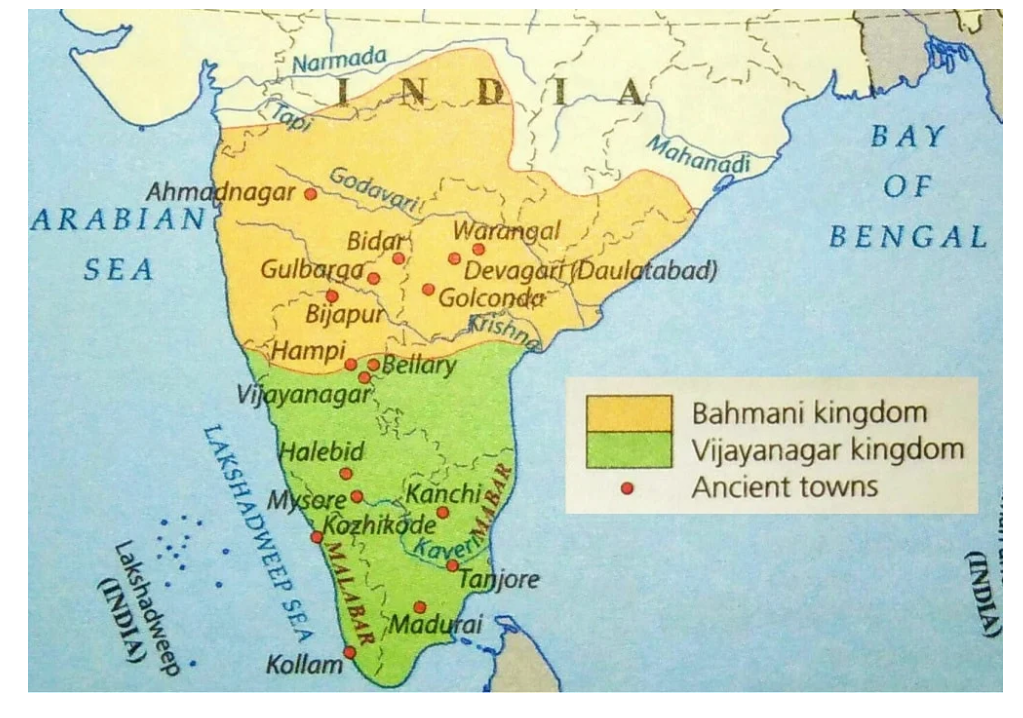
- Founded in 1336 AD by Harihara and Bukka, known as the “City of Victory.”
- The empire frequently fought with the Deccan Sultans and the Gajapati rulers of Odisha.
Four Dynasties of Vijayanagara
- Sangama Dynasty (1336–1485 AD)
- Harihara and Bukka belonged to this dynasty.
- Saluva Dynasty (1485–1505 AD)
- Founded by Narasimha.
- Tuluva Dynasty (1505–1570 AD)
- Founded by Vir Narasimha. Krishnadeva Raya belonged to this dynasty.
- Aravidu Dynasty (1570– 1650 AD)
- Founded by Tirumala.
Important Indigenous Sources
- Amuktamalyada – Krishna Deva Raya; provides insights into administration and political ideas.
- Manucharitam – Allasani Peddana; describes social conditions and the caste system.
- Madhuravijayam – Gangadevi; narrates Kumara Kampana’s conquest of Madurai under Bukka I.
- Gangadasa Pralapa Vilasam – Gangadhara; discusses the siege of Vijayanagara after Deva Raya II’s death.
- Saluvabhyudayam – Rajanattha Dindima; a historical eulogy of the Saluva dynasty.
Archaeological Sources
- Bagapalli Copper Inscription (Harihara I): Records his achievements.
- Srirangam Copper Plate (Devaraya II): Important source on his reign.
- Devulapalli Copper Plates (Immadi Narasimha): Provide the genealogy of the Saluva dynasty.
Numismatic Sources
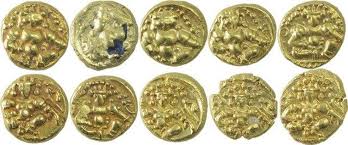
- Vijayanagara rulers issued gold coins called Varahas.
- Types: Full Varaha, Half Varaha, and Quarter Varaha.
- Obverse: Depicted Hindu deities and animals such as the bull, elephant, and Gandaberunda (double-headed eagle).
- Reverse: Carried the king’s name in Nagari or Kannada script.
- Some quarter Varahas of Deva Raya II describe him as “Gajabentakara.”
Foreign Travellers’ Accounts of Vijayanagara
- Ibn Battuta (Moroccan): Described the empire during Harihara I’s reign in Rihla.
- Nicolo de Conti (Italian): Visited during the reign of Deva Raya I.
- Abdur Razzak (Persian): Recorded the reign of Deva Raya II in Matla-us-Sadain wa Majma-ul-Bahrain.
- Domingo Paes (Portuguese): Stayed at Krishnadeva Raya’s court and gave a detailed account of his personality and administration.
Administration of the Vijayanagara Empire
Theory of Kingship
- Based on absolute monarchy with an emphasis on benevolent rule.
- The king was the supreme executive, legislator, judge, and final court of appeal.
Law of Succession
- Generally followed the hereditary principle.
- Rulers sometimes nominated successors for smooth transitions.
- Usurpation occurred (e.g., Saluva Narasimha ended Sangama rule).
- Regents governed when the heir was a minor.
Central Administration
- Assisted by a Council of Ministers headed by a Prime Minister.
- The king was not bound by ministerial advice.
- Administration functioned through various departments under royal officers.
Provincial Administration
- Administrative divisions: Mandalam (province) → Nadu (district) → Sthala (sub-district) → Grama (village).
- Mandaleswaras/Nayaks governed provinces.
- Governors enjoyed considerable autonomy, maintaining courts, armies, and sometimes issuing coins.
- Gauda was the village headman.
Revenue Administration
- Main source: Land revenue from crown lands.
- Other sources: tributes, customs duties, tolls, professional taxes, market taxes, licenses, and fines.
- Revenue was assessed through land surveys.
- Generally, 1/6th of the produce was collected, though it could reach 50%.
- According to Amuktamalyada, expenditure was divided into:
- Charity and royal expenses,
- Maintenance of horses,
- Military campaigns,
- Defence of the empire.
Judicial Administration
- The king presided over the Sabha, the highest court.
- Village courts, caste panchayats, and guilds handled minor disputes.
- Decisions were largely based on Dharmashastras.
- Punishments were often severe, including mutilation and execution by elephants.
Military Administration
- Maintained a well-organized army with imported Arabian horses.
- Introduced the Amara-Nayaka system, influenced by the Iqta system of the Delhi Sultanate.
- Amara-Nayakas:
- Were military commanders.
- Collected taxes and maintained troops.
- Paid annual tribute and attended the royal court.
- Could be transferred by the king from one place to another.
- Senior military chiefs were known as Nayaks, Palaiyagars, or Poligars.
- In the 17th century, several Nayakas (e.g., Tanjore and Madurai) became independent rulers.
Social Conditions
- Allasani Peddana’s Manucharitam mentions four social groups:
- Viprulu (Brahmins): Teachers and priests.
- Rajulu/Rachavaru: Ruling and warrior class; many rulers and generals were Sudras but held this status due to their position.
- Matikaratalu (Vaishyas): Merchants engaged in trade and commerce.
- Nalavajativaru (Sudras): Mainly agriculturists, though some followed other occupations.
- The Kshatriya varna was largely absent in South India.
- Nicolo Conti refers to the prevalence of slavery.
- The Sangama rulers followed Shaivism, worshipping Virupaksha , while later dynasties leaned towards Vaishnavism.
- The Dvaita philosophy of Madhavacharya was also influential.
- Epics and Puranas were widely popular among the masses.
- The status of women improved only marginally:
- Gangadevi, author of Madhuravijayam, was a notable scholar.
- Sati (Sahagaman) and the Devadasi system continued.
- Polygamy was common among royal families.
- Popular forms of entertainment included dance, music, wrestling, gambling, and cockfighting.
- Silk and cotton garments were commonly worn.
Economic Conditions of the Vijayanagara Empire
- The Vijayanagara Empire was one of the wealthiest states of the 15th–16th centuries, praised by foreign travellers for its prosperity and grandeur.
Agriculture
- Agriculture was the main occupation of the people.
- Rulers promoted irrigation by constructing dams and tanks.
- Kamalapuram Tank (early 15th century) is a notable example.
Industries
- Major industries included textiles, mining, metallurgy, and perfumery.
- Guilds regulated industries and crafts.
- Important diamond mines were located in Kurnool and Anantapur.
Trade and Commerce
- Varaha was the principal gold coin.
- Trade was highly developed, though weights and measures varied regionally.
- Cannanore was the principal port on the Malabar Coast.
- Exports: Cotton and silk textiles, spices, rice, iron, saltpetre, and sugar.
- Imports: Horses, pearls, copper, coral, mercury, Chinese silk, velvet, sandalwood, and elephants.
- Maintained extensive trade links with Arabia, Persia, South Africa, Portugal, Burma, the Malay Peninsula, and China.
- The empire possessed its own ships, indicating knowledge of shipbuilding.
Battle of Talikota (1565 CE)
- Fought on 23 January 1565 between the Vijayanagara Empire and the Grand Shahi Confederacy.
- Also known as the Battle of Rakkasa-Tangadi or Battle of Bannihatti.
- Aliya Rama Raya led the Vijayanagara forces.
- The opposing alliance comprised the Adil Shahis of Bijapur, Nizam Shahis of Ahmadnagar, Qutb Shahis of Golconda, and Barid Shahis of Bidar.
Causes
- Struggle for control over the fertile Raichur Doab (between the Krishna and Tungabhadra rivers).
- Religious and cultural differences between Vijayanagara and the Deccan Sultanates.
- Aliya Rama Raya’s interference in Sultanate politics through a “divide and rule” policy, leading to the formation of the Shahi Confederacy.
- The immediate cause was Ali Adil Shah’s demand for the return of Raichur, which Rama Raya refused, leading to war.
Aftermath
- The battle marked the decline of Vijayanagara’s political dominance in South India.
- The victorious armies sacked and devastated the city of Vijayanagara, which never fully recovered.
- The weakened empire shifted its capital to Penukonda, and later to Chandragiri and Vellore.
- Tirumala, brother of Aliya Rama Raya, assumed leadership and founded the Aravidu dynasty.
- The Nayaks of Madurai, Tanjore, and Gingee gradually asserted their independence.
- The collapse of Vijayanagara led to the fragmentation of political authority in South India, paving the way for the rise of regional powers.
Causes of the Defeat of the Vijayanagara Empire (Battle of Talikota, 1565)
- Weak cavalry: Vijayanagara had fewer horsemen and relied heavily on war elephants, while the Sultanates possessed superior Persian cavalry.
- Aged leadership: Key Vijayanagara commanders, including Aliya Rama Raya, were elderly, unlike the younger Sultanate generals.
- Inferior weaponry: Vijayanagara infantry used bamboo bows and shorter spears, whereas the Sultanates employed metal crossbows and longer cavalry spears, giving them a tactical edge.
- Artillery disadvantage: The Sultanates had well-trained Turkestani gunners and an efficient artillery force, while Vijayanagara depended on less experienced European mercenaries.
- Betrayal of the Gilani brothers: The Gilani brothers, senior Vijayanagara commanders formerly associated with the Adil Shahi kingdom, deserted during the battle, significantly weakening the Vijayanagara army.
- Accounts of this betrayal are supported by Frendricci and Anquetil Du Perron, who wrote about Vijayanagara after the conflict.
Ashtadiggajas
- The Ashtadiggajas were the eight Telugu poets and scholars in the court of Krishnadeva Raya.
- The Ashtadiggajas, referred to as elephants in the eight directions.
- Their presence made Krishnadeva Raya’s reign the Golden Age of Telugu Literature.
The Eight Ashtadiggajas:
- Allasani Peddana
- Nandi Thimmana
- Madayyagari Mallana
- Dhurjati
- Pingali Surana
- Tenali Ramakrishna
- Ayyalaraju Ramabhadrudu
- Ramarajabhushanudu
Krishnadeva Raya (1509–1529 CE)
- Greatest ruler of the Vijayanagara Empire; known as Abhinava Bhoja, Andhra Bhoja, and Andhra Pitamaha.
- Defeated the Bahmani forces in the Battle of Diwani.
- Conquered the Raichur Doab after defeating Ismail Adil Shah of Bijapur (1520 CE).
- Captured Gulbarga and Bidar after defeating Amir Barid.
- Defeated Gajapati Prataprudra of Odisha and brought Telangana under his control.
- Maintained friendly relations with the Portuguese; Domingo Paes and Barbosa visited during his reign.
- Supported the establishment of Portuguese rule in Goa (1510 CE).
- A follower of Vaishnavism, but showed tolerance towards all religions.
- Patronized the Ashtadiggajas, with Allasani Peddana regarded as the Andhra Kavita Pitamaha.
- Authored Amuktamalyada (Telugu) and Jambavati Kalyanam and Ushaparinayam (Sanskrit).
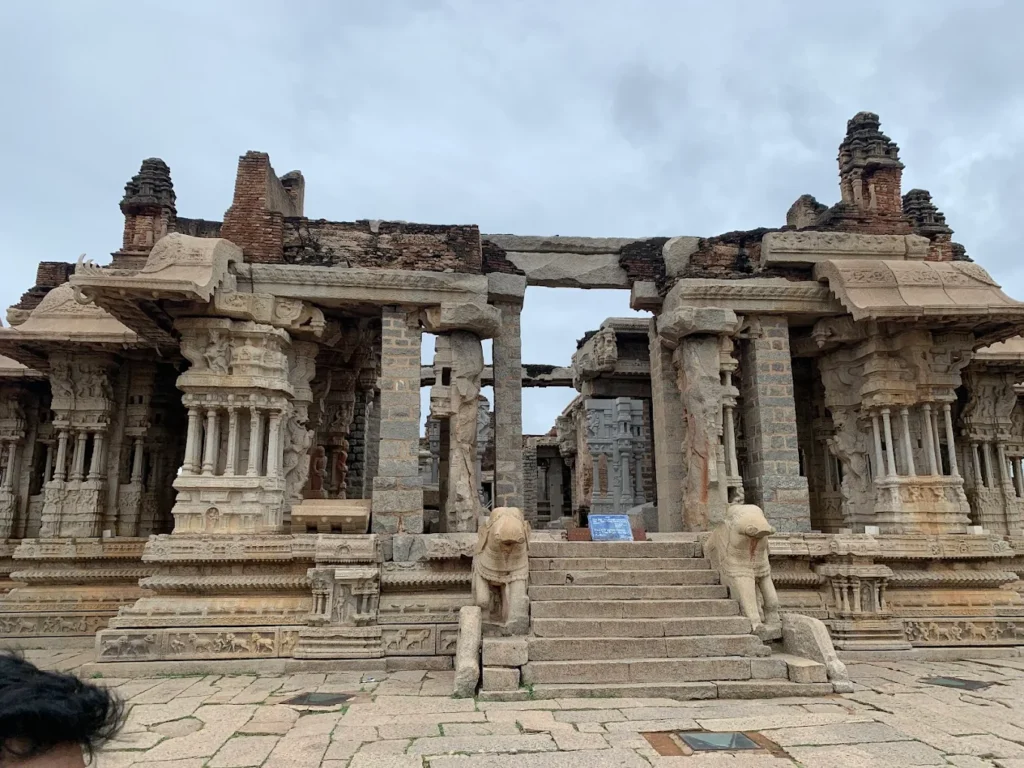
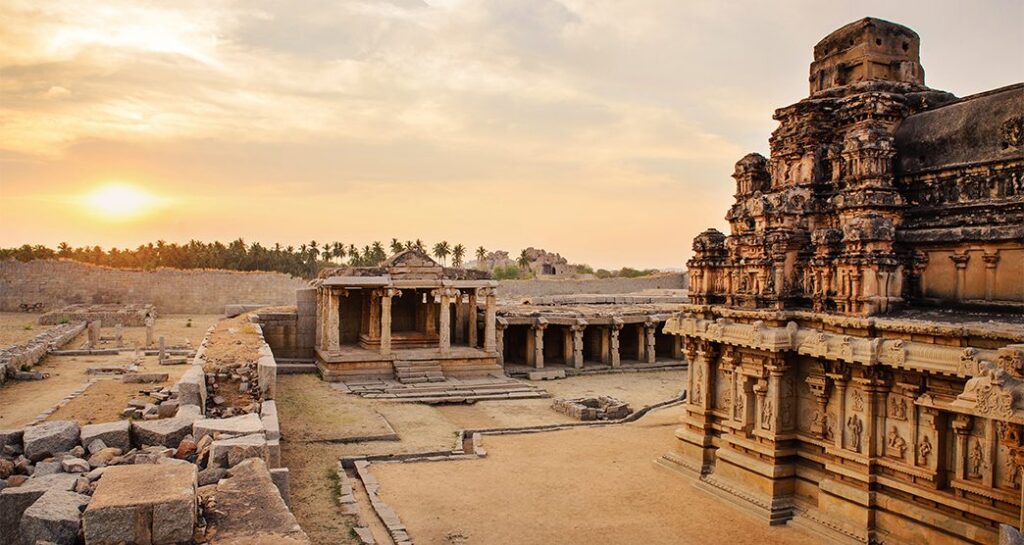
- Promoted temple architecture, including the Vittalaswami Temple and Hazara Ramaswamy Temple at Vijayanagara.
- Founded Nagalapuram in memory of his mother.
- Remembered as a capable administrator, military strategist, and great patron of art and literature.
- Information about his reign is preserved in over 2,000 inscriptions and epigraphs.
UPSC CSE Prelims PYQ
Q. Who among the following rulers of Vijayanagara Empire constructed a large dam across Tungabhadra River and a canal-cum-aqueduct several kilometres long from the river to the capital city? 2023
(a) Devaraya I
(b) Mallikarjuna
(c) Vira Vijaya
(d) Virupaksha
Correct Answer: A
Explanation: Deva Raya I ( Sangama dynasty)constructed a dam across the Tungabhadra River to supply water to the city through canals and address water scarcity. He also built a dam on the Haridra River to promote irrigation.
Q.According to Portuguese writer Nuniz, the women in Vijayanagara Empire were experts in which of the following areas? 2021
1.Wrestling
2.Astrology
3.Accounting
4.Soothsaying
Select the correct answer using the code given below.
(a) 1, 2 and 3 only (b) 1, 3 and 4 only
(c) 2 and 4 only (d) 1, 2, 3 and 4
Correct Answer: D
Explanation: According to Fernao Nuniz, the Vijayanagara king employed women as wrestlers, accountants, astrologers, and soothsayers in his court. Fernao Nuniz was a Portuguese traveller who visited the Vijayanagar empire during the reign of Achyuta Deva Raya.
About Lucent IAS
Lucent IAS is a premier coaching institute in Guwahati, dedicated to empowering APSC aspirants with a result-oriented approach. Recognized as a top destination for APSC Coaching, we offer comprehensive guidance ranging from Foundation Courses and Advanced Mains preparation to our signature Assam-Centric study modules. With expert faculty, small batch sizes for personalized mentoring, and the acclaimed Saadhana Test Series, Lucent IAS is committed to helping you crack the Civil Services Examination.
Publications From LUCENT IAS
- “The Assam Odyssey: The Complete Assam Centric Resource useful for APSC CCE and various other Departmental Examinations. Read More
- InExam PYQ Explained.Read More
- Mains Tattva: The Craft of Answer Writing (GS Paper PYQs). Read More
- Maanchitra – An Illustrative Colour-Coded Informative Map of Assam. Read More
- প্ৰাৰম্ভ (Prarambha). Read More
- অসম ওডিচী – The Assam Odyssey (Assamese Edition). Read More
Start your journey to success today. Visit us at lucentias.com or call +91-6913007777 for more details.