

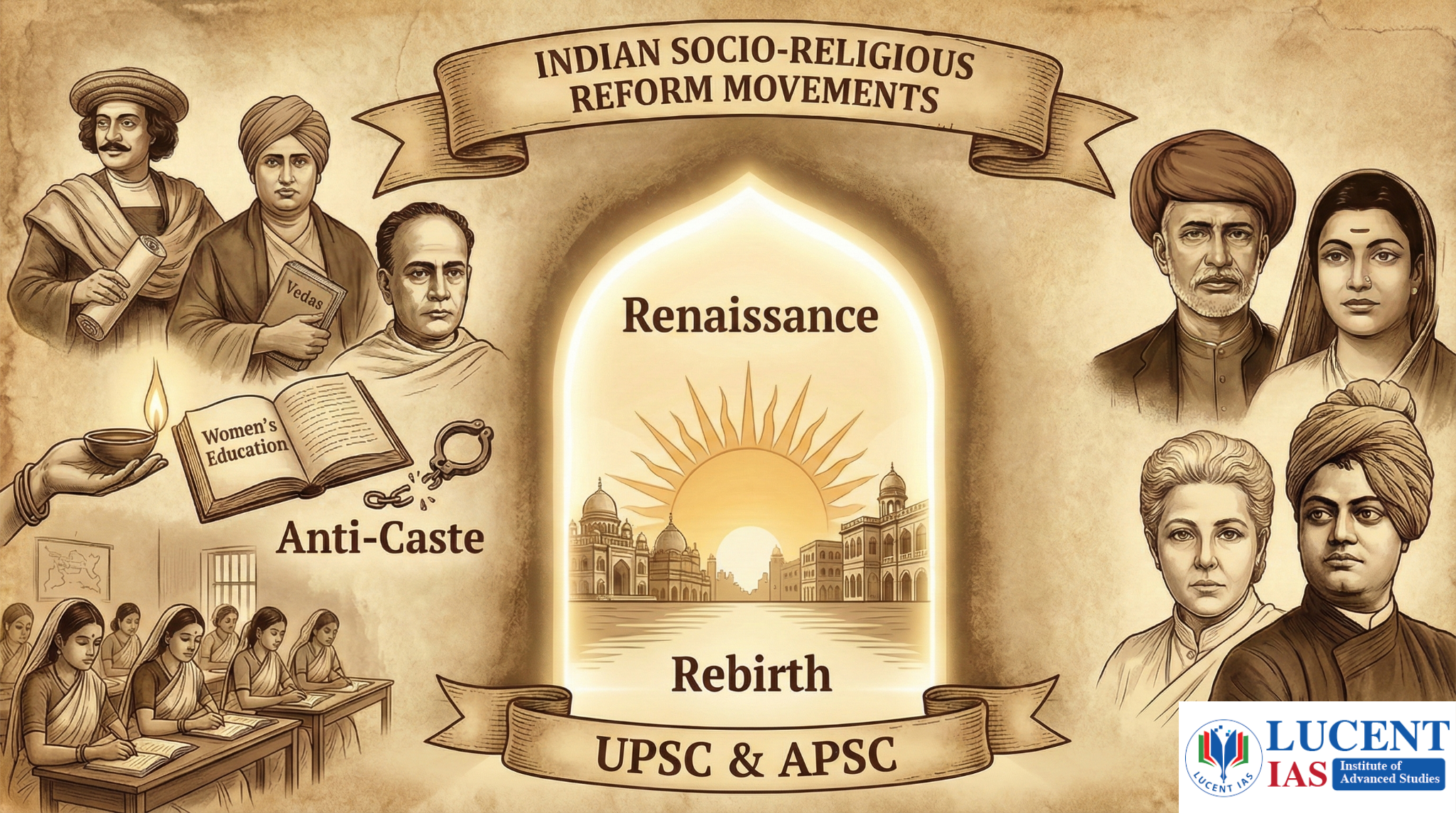
Master the Indian Renaissance for UPSC & APSC. Comprehensive notes on Socio-Religious Reform Movements, covering Brahmo Samaj, Arya Samaj, women’s rights, and key leaders like Raja Ram Mohan Roy and Jyotiba Phule. Read More Below.
The term ‘Renaissance’ literally means rebirth and is commonly used to refer to the renewed interest in the classical civilizations of Greece and Rome, which had a profound impact on Europeans. However, the Renaissance was not solely a revival of ancient knowledge; it brought about significant advancements in art, literature, religion, philosophy, science, and politics.
Features of the Indian Renaissance
1. Reformist Movements
- Brahmo Samaj (1828): Founded by Raja Ram Mohan Roy; promoted monotheism, rationalism, and social reforms.
- Prarthana Samaj (1867): Founded by Dr. Atmaram Pandurang, supported by M.G. Ranade; encouraged women’s education, widow remarriage, and social reform.
- Aligarh Movement (1875): Led by Sir Syed Ahmed Khan; promoted modern education through the Muhammadan Anglo-Oriental College (later AMU).
2. Revivalist Movements
- Deoband Movement (1866): Founded by Muhammad Qasim Nanautawi and Rashid Ahmad Gangohi; established Darul Uloom Deoband to revive Islamic education.
- Arya Samaj (1875): Founded by Swami Dayanand Saraswati; promoted Vedic principles, opposed idol worship, and supported social reforms.
- Wahabi Movement: Led by Syed Ahmed Barelvi and Shah Waliullah; emphasized purification of Islamic practices and resistance to British rule.
3. Women-Centric Reforms
- Abolition of Sati (1829): Raja Ram Mohan Roy’s campaign led to the Bengal Sati Regulation Act enacted by Lord William Bentinck.
- Widow Remarriage (1856): Ishwar Chandra Vidyasagar’s efforts resulted in the Hindu Widows’ Remarriage Act.
- Women’s Education (1848 onwards): Savitribai Phule and Jyotiba Phule opened the first girls’ school in Pune; Pandita Ramabai promoted education through the Arya Mahila Samaj.
- Child Marriage Restraint Act (1929): Championed by Harbilas Sarda; fixed the minimum marriage age at 18 for boys and 14 for girls.
4. Religious Reinterpretation and Cultural Awakening
- Young Bengal Movement: Led by Henry Louis Vivian Derozio; encouraged rational thinking and social reform.
- Theosophical Society (1875): Annie Besant promoted Indian spiritual thought, education, and the Home Rule Movement.
- Ramakrishna Mission (1897): Founded by Swami Vivekananda, inspired by Ramakrishna Paramhansa; focused on spiritual education and social service.
5. Challenges to the Caste System
- Satya Shodhak Samaj (1873): Founded by Jyotiba Phule to fight caste discrimination and uplift oppressed communities.
- Self-Respect Movement: Started by E.V. Ramasamy Periyar; promoted equality, inter-caste marriages, and temple reforms.
- Temple Entry Movements: The Vaikom Satyagraha (1924) and Guruvayur Satyagraha (1931) opposed caste-based discrimination.
6. Educational and Social Impact
- Women’s Education: Institutions like Bethune School, Kolkata (1849) advanced female education.
- Social Awareness: Reformers used publications such as Sambad Kaumudi and Gulamgiri to spread awareness.
- Legal Reforms: Acts like the Hindu Widows’ Remarriage Act (1856) and Sarda Act (1929) brought major social changes.
7. Influence on Nationalism
- Ganesh and Shivaji Festivals: Organized by Bal Gangadhar Tilak to promote unity and national consciousness.
- Swadeshi Movement: Reformers supported indigenous goods and the boycott of foreign products.
- Religious Unity: Swami Vivekananda’s speech at the Chicago Parliament of Religions (1893) emphasized harmony and national integration.
Factors Leading to Socio-Religious Reform Movements in India
- Impact of Western Education:The introduction of modern Western education played a crucial role in creating intellectual awareness in India. Exposure to ideas such as reason, rationalism, liberty, and humanism encouraged educated Indians to critically examine existing social and religious practices.
- Growing Awareness of Social Evils:With increasing interaction and public debate, harmful practices such as sati, female infanticide, and child marriage began to receive widespread attention. Reformers felt a strong need to remove these practices to improve the condition of society.
- Influence of Rationalism and Secular Thinking:The spread of rational and scientific thought inspired many intellectuals to evaluate customs and traditions more critically. Religious and social practices increasingly began to be judged on the basis of reason rather than blind faith.
- Role of the Press and Intellectual Exchange:The growth of newspapers, journals, and pamphlets made it easier to spread reformist ideas among the public. The press helped generate awareness, encouraged discussion, and created an atmosphere favorable to social reform.
- Differences in Social Outlook:Indian society witnessed a gradual division of opinion. While some groups preferred to preserve traditional customs, others believed that adopting modern and scientific ideas could help reform and strengthen society.
- Emergence of New Social Groups:The rise of a modern middle class, intelligentsia, and other emerging groups increased the demand for social and educational reforms. These groups actively supported efforts aimed at modernization.
- Re-examination of Cultural Traditions:Reformers did not reject Indian traditions entirely. Instead, they carefully studied their cultural and religious heritage, discarding outdated practices while preserving valuable and progressive elements.
- Legislative and Social Reform Initiatives:Many reformers worked towards bringing legal changes to abolish oppressive practices. At the same time, social organizations carried out awareness campaigns and reform activities at the community level.
Raja Rammohan Roy and Brahmo Samaj
Role and Contribution
- Raja Rammohan Roy, often regarded as the first major leader of modern India, worked to reform a society affected by rigid caste practices and social stagnation.
- He strongly opposed idol worship, caste rigidity, and meaningless rituals, and criticised the role of the priestly class in sustaining such practices.
- His efforts marked the beginning of a broader intellectual and social awakening in India.
Philosophical Contributions and Religious Reforms
- He believed that monotheism formed the core of ancient Hindu scriptures.
- To support his views, he published Bengali translations of the Vedas and important Upanishads.
- He emphasized human reason as an essential guide in interpreting religious ideas.
- He described God, following the Upanishads, as formless and invisible.
- In 1820, he published The Precepts of Jesus, highlighting the moral and rational teachings of Jesus.
- He founded the Atmiya Sabha (1814) in Bengal to promote discussions on philosophy and monotheism.
- In 1828, he established the Brahmo Samaj, which aimed to promote monotheism and reform Hindu religious practices.
- The Brahmo Samaj was guided by reason and the teachings of the Vedas and Upanishads, while respecting other religions.
- It condemned idol worship, upheld human dignity, and opposed social evils such as Sati.
Educational Initiatives
- Raja Rammohan Roy strongly supported modern education as a tool for social progress.
- He worked with David Hare in establishing Hindu College (1817).
- In the same year, he founded an English School in Calcutta, promoting the study of modern subjects and Western thought.
- In 1825, he set up Vedanta College, where both Western sciences and Indian philosophy were taught, encouraging a synthesis of knowledge.
Contribution to Journalism
- He used the press as a medium of reform and public awareness.
- In 1821, he started the Bengali weekly Sambad Kaumudi, which discussed social issues and campaigned against Sati.
- In 1822, he launched Mirat-ul-Akhbar, the first Persian weekly in India, focusing on political developments and colonial policies.
- Through his writings, he openly criticised unjust policies of the British government.
Opposition and Growth of the Brahmo Samaj
- His reformist ideas faced resistance from orthodox groups, leading to the formation of the Dharma Sabha.
- He received support from prominent figures such as Dwarkanath Tagore, Prasanna Kumar Tagore, Chandrashekhar Deb, and Tarachand Chakravarti.
- After his death, the Brahmo Samaj was led by Devendranath Tagore (1843) and later by Keshab Chandra Sen (1866).
- Keshab Chandra Sen expanded the movement to different parts of India and promoted reforms related to caste, women’s rights, and widow remarriage.
- Differences in ideology eventually led to a split into the Adi Brahmo Samaj and the Brahmo Samaj of India.
Vision of Internationalism and Legacy
- Raja Rammohan Roy believed in international cooperation and the free exchange of ideas among nations.
- Rabindranath Tagore praised his vision, noting his deep understanding of the spirit of the modern age.
- Through his work in religion, education, journalism, and social reform, he laid the foundation for the modernization of Indian society and inspired later reform movements.
Young Bengal Movement and Henry Louis Vivian Derozio
Origin and Leadership
- The Young Bengal Movement emerged in Bengal during the late 1820s and early 1830s.
- It was led by Henry Louis Vivian Derozio, a teacher at Hindu College (1826–1831).
- Derozio inspired students to think critically, question authority, and uphold liberty, equality, and freedom.
- He promoted rational thinking and discouraged blind adherence to traditional practices.
Ideas and Activities
- The followers of Derozio, known as the Derozians, opposed social orthodoxy and regressive customs.
- They strongly supported women’s rights and women’s education.
- They used the press and public debates to spread awareness on social, economic, and political issues.
- The group demanded freedom of the press, trial by jury, fair treatment of Indian labourers, and Indian representation in higher government services.
- They also raised their voice for the protection of peasants from exploitation by zamindars.
Limitations of the Movement
- The ideas of the Derozians were too radical for the society of that time, which limited their acceptance.
- They found it difficult to build a strong connection with the masses, especially peasants.
- The absence of broad social support restricted the overall impact of the movement.
Significance
- The movement initiated public debate on important issues, including legal reforms and the revision of the East India Company’s Charter.
- Although its immediate achievements were limited, the Young Bengal Movement helped promote critical thinking, rationalism, and the spirit of reform, influencing later socio-religious movements in India.
Debendranath Tagore
- Debendranath Tagore was an important leader of the socio-religious reform movement in Bengal, influenced by both Indian philosophical traditions and modern Western ideas.
- He founded the Tattvabodhini Sabha (1839) to promote the rational and humanistic teachings of Vedanta and the Upanishads and to counter missionary criticism.
- The Sabha encouraged the study of Indian culture and history and published the Tattvabodhini Patrika in Bengali.
- It attracted noted intellectuals such as Ishwar Chandra Vidyasagar and Akshay Kumar Dutt.
- In 1843, he revived the Brahmo Samaj and expanded its reform activities.
- The Samaj supported women’s education, widow remarriage, opposition to polygamy, and social uplift of peasants.
- He respected Vedic teachings but rejected the idea of their infallibility, advocating a rational and inclusive approach to religion.
Ishwar Chandra Vidyasagar
- Ishwar Chandra Vidyasagar was a leading 19th-century social reformer known for his contributions to education and women’s rights.
- He actively promoted women’s education and served as Secretary of Bethune School (1849), India’s first permanent school for girls.
- He strongly opposed child marriage and polygamy and worked for the social upliftment of women.
- His efforts led to the enactment of the Hindu Widow Remarriage Act (1856), and the first legal widow remarriage among upper-caste Hindus took place under his guidance.
- As Principal of Sanskrit College (from 1851), he introduced Western ideas and opened the institution to non-Brahmin students, promoting inclusive education.
- He made lasting contributions to Bengali literature through Barnaparichay, which helped shape modern Bengali prose.
- Vidyasagar’s work reflected his lifelong commitment to social equality, education, and reform.
Jyotiba Phule
- Jyotiba Phule was a leading social reformer who worked for the uplift of lower castes, women, and marginalized communities.
- Promoted education for women and lower castes and, along with Savitribai Phule, started schools for girls and marginalized groups.
- Established a shelter for widows and supported widow remarriage.
- Founded an orphanage (1854) to care for abandoned children and widows.
- Strongly opposed Brahminical dominance, caste discrimination, and social inequality.
- Founded the Satya Shodhak Samaj (1873) to promote social equality and awareness against caste prejudice.
- Used the term “Dalit” to refer to oppressed communities.
- Important works include Gulamgiri, Sarvajanik Satyadharma Pustak (1879), and writings on the Satya Shodhak Samaj.
Savitribai Phule
- Savitribai Phule was a pioneering educator and social reformer who worked for women’s education and social equality.
- Opened the first school for girls in Pune (1848) with Jyotiba Phule and later established more schools for girls and marginalized communities.
- Founded the Mahila Seva Mandal (1852) to create awareness about women’s rights and dignity.
- Opposed social evils such as forced shaving of widows’ heads and other discriminatory customs.
- Started night schools (1855) for workers and provided stipends to encourage education.
- Established Balhatya Pratibandhak Griha (1863) to prevent female infanticide and support widows.
- Played an important role in the Satya Shodhak Samaj and continued its work after Jyotiba Phule’s death.
- Participated in famine relief efforts and social service activities.
- Literary works include Kavya Phule and Bavan Kashi Subodh Ratnakar.
Ramakrishna Paramhansa and Swami Vivekananda
- Ramakrishna Paramhansa (1834–1886) was a spiritual saint who sought religious truth through devotion, meditation, and renunciation.
- He believed in the unity of all religions and practiced different faiths, including Islam and Christianity, to understand their spiritual essence.
- His teachings emphasized that all paths can lead to the realization of God and that service to humanity is a form of worship.
- His simple message of faith, tolerance, and universal spirituality influenced many followers, most notably Swami Vivekananda.
- Swami Vivekananda (1863–1902) was the chief disciple of Ramakrishna Paramhansa and played a key role in spreading his teachings in India and abroad.
- Between 1893 and 1897, he traveled across America and Europe, presenting the ideas of Vedanta and spiritual Hinduism to the world.
- After returning to India, he founded the Ramakrishna Mission (1897) to promote social service, education, and humanitarian work, and established Belur Math as its headquarters.
- Vivekananda strongly criticized social evils such as caste discrimination, untouchability, and excessive ritualism.
- He warned that reducing religion to narrow ideas of purity and impurity weakened the true spirit of spirituality.
- At the same time, he took pride in India’s spiritual heritage and believed that Vedanta represented a rational and comprehensive philosophy.
- Vivekananda advocated a balanced approach, encouraging Indians to adopt Western advancements in science, technology, and organization while preserving their spiritual traditions.
- He strongly supported freedom of thought and expression, believing that liberty was essential for the growth of individuals and nations.
- His vision was to revive India’s spiritual strength, promote social reform, and inspire people to overcome superstition through reason and self-confidence.
Arya Samaj and Swami Dayanand Saraswati
Arya Samaj was founded by Swami Dayanand Saraswati (1824–1883) in Bombay to reform Hindu society and promote the teachings of the Vedas.
Core Philosophy:
- Believed the Vedas were the highest source of knowledge.
- Gave the slogan “Back to the Vedas.”
- Supported monotheism and rejected idol worship, polytheism, and superstitions.
- Encouraged direct worship of God without intermediaries.
Social Reforms:
- Opposed untouchability and rigid caste practices.
- Supported women’s education, inter-caste marriage, and social equality.
- Gave the slogan “Back to the Vedas.”
- Initiated the Shuddhi Movement to reconvert those who had left Hinduism.
- Educational Contributions:
- Followers established many institutions to promote education.
- Lala Hansraj helped develop the Dayanand Anglo-Vedic (DAV) institutions.
- Swami Shraddhananda promoted Gurukul education based on Vedic traditions.
Important Work:
- Satyarth Prakash, written by Swami Dayanand, explained his religious and reformist ideas.
Split in Arya Samaj (1893):
- Differences over education and ideology led to a division into the DAV Group (modern education) and the Gurukul Group (traditional education).
Prarthana Samaj
- Prarthana Samaj was founded in 1867 in Bombay by Atmaram Pandurang and supported by Mahadev Govind Ranade.
- It was inspired by the Brahmo Samaj and aimed at reforming Hindu society.
- Promoted monotheism and opposed idol worship, caste discrimination, and priestly dominance.
- Advocated widow remarriage, female education, raising the age of marriage, and social equality.
- Established schools, orphanages, and welfare institutions to promote education and social reform.
- Influenced by the teachings of Bhakti saints like Tukaram and Namdev.
- Key contributors included M.G. Ranade and R.G. Bhandarkar; its influence also spread to South India through Kandukuri Viresalingam.
The Theosophical Movement
- The Theosophical Society was founded in 1875 by H.P. Blavatsky and H.S. Olcott in the United States.
- Aimed to promote ancient religions, philosophy, and universal brotherhood.
- Introduced in India in 1879; headquarters established at Adyar (Madras).
- Under Annie Besant, it gained popularity and encouraged pride in Indian culture and spiritual traditions.
- Promoted ideas such as transmigration of the soul, religious harmony, and cultural revival.
- Annie Besant founded the Central Hindu School at Benaras, later associated with Banaras Hindu University.
- Supported women’s rights,education, and opposition to untouchability.
Wahabi Movement
- The Wahabi Movement (1830–1860) was led by Syed Ahmed Barelvi, influenced by Abdul Wahab and Shah Waliullah.
- Aimed at purifying Islam and removing un-Islamic practices.
- Opposed religious corruption and social evils, calling for a return to fundamental Islamic principles.
- Patna served as the main center, and the movement spread to Bengal, Bombay, UP, Hyderabad, and Madras.
- In some regions, especially Bengal, it also took the form of a peasant movement against landlord exploitation.
Deoband Movement (Deoband School)
- The Deoband Movement was founded in 1866 by Muhammad Qasim Nanautavi and Rashid Ahmad Gangohi at Deoband.
- Aimed at moral and religious reform of Muslims by spreading the teachings of the Quran and Hadith.
- Worked to preserve Islamic identity and resist foreign influence.
- Criticized certain Sufi devotional practices that were seen as un-Islamic.
- The movement later welcomed the formation of the Indian National Congress, showing engagement with contemporary political developments.
APSC UPSC Previous Year Questions
Prelims
(UPSC Prelims 2021 )
Q.With reference to Madanapalle of Andhra Pradesh, which one of the following statements is correct?
(a) Pingali Venkayya designed the tricolor Indian National Flag here.
(b) Pattabhi Sitaramaiah led the Quit India Movement of Andhra region from here.
(c) Rabindranath Tagore translated the National Anthem from Bengali to English here.
(d) Madame Blavatsky and Colonel Olcott set up headquarters of Theosophical Society first here.
Correct Answer: C
Explained: Only statement C is correct.
Pingali Venkayya: While he designed the flag, he presented an early version of the tricolour to Mahatma Gandhi at the Indian National Congress session in Vijayawada (1921), not Madanapalle.
Pattabhi Sitaramaiah: While a prominent leader from Andhra, Madanapalle is not historically cited as the specific center from which he led the Quit India Movement.
Theosophical Society: Madame Blavatsky and Colonel Olcott shifted the headquarters of the Theosophical Society to Adyar (Chennai) in 1882. Madanapalle is home to the Besant Theosophical College but was not the first headquarters.
(UPSC Prelims 2025)
Q.Consider the following statements about Raja Ram Mohan Roy:
He possessed great love and respect for the traditional philosophical systems of the East.
He desired his countrymen to accept the rational and scientific approach and the principle of human dignity and social equality of all men and women.
Which of the statements given above is/are correct?
(a) 1 only
(b) 2 only
(c) Both 1 and 2
(d) Neither 1 nor 2
Correct Answer: C
Explained: Both the Statements are correct.
Mains
(APSC CCE 2023)
Q.What are the two broad categories of socio-religious reform movements in colonial India? How far the western impact contributed to the growth and development of the socio-religious reform movements? (Write in 250 words) 15
(APSC CCE 2022)
Q. Discuss briefly the influence of the Brahmo Movement on Assamese society in the 19th century.( Write in 250 words)15
(UPSC CSE 2021)
Q. Trace the rise and growth of socio-religious reform movements with special reference to Young Bengal and Brahmo Samaj. (Write in 150 words) 10
(UPSC CSE 2017)
Q.The women’s questions arose in modern India as a part of the 19th century social reform movement. What were the major issues and debates concerning women in that period? ( Write in 150 words) 10
About Lucent IAS
Lucent IAS is a premier coaching institute in Guwahati, dedicated to empowering APSC aspirants with a result-oriented approach. Recognized as a top destination for APSC Coaching, we offer comprehensive guidance ranging from Foundation Courses and Advanced Mains preparation to our signature Assam-Centric study modules. With expert faculty, small batch sizes for personalized mentoring, and the acclaimed Saadhana Test Series, Lucent IAS is committed to helping you crack the Civil Services Examination.
Publications From LUCENT IAS
- “The Assam Odyssey: The Complete Assam Centric Resource useful for APSC CCE and various other Departmental Examinations. Read More
- InExam PYQ Explained.Read More
- Mains Tattva: The Craft of Answer Writing (GS Paper PYQs). Read More
- Maanchitra – An Illustrative Colour-Coded Informative Map of Assam. Read More
- প্ৰাৰম্ভ (Prarambha). Read More
- অসম ওডিচী – The Assam Odyssey (Assamese Edition). Read More
Start your journey to success today. Visit us at lucentias.com or call +91-6913007777 for more details.