

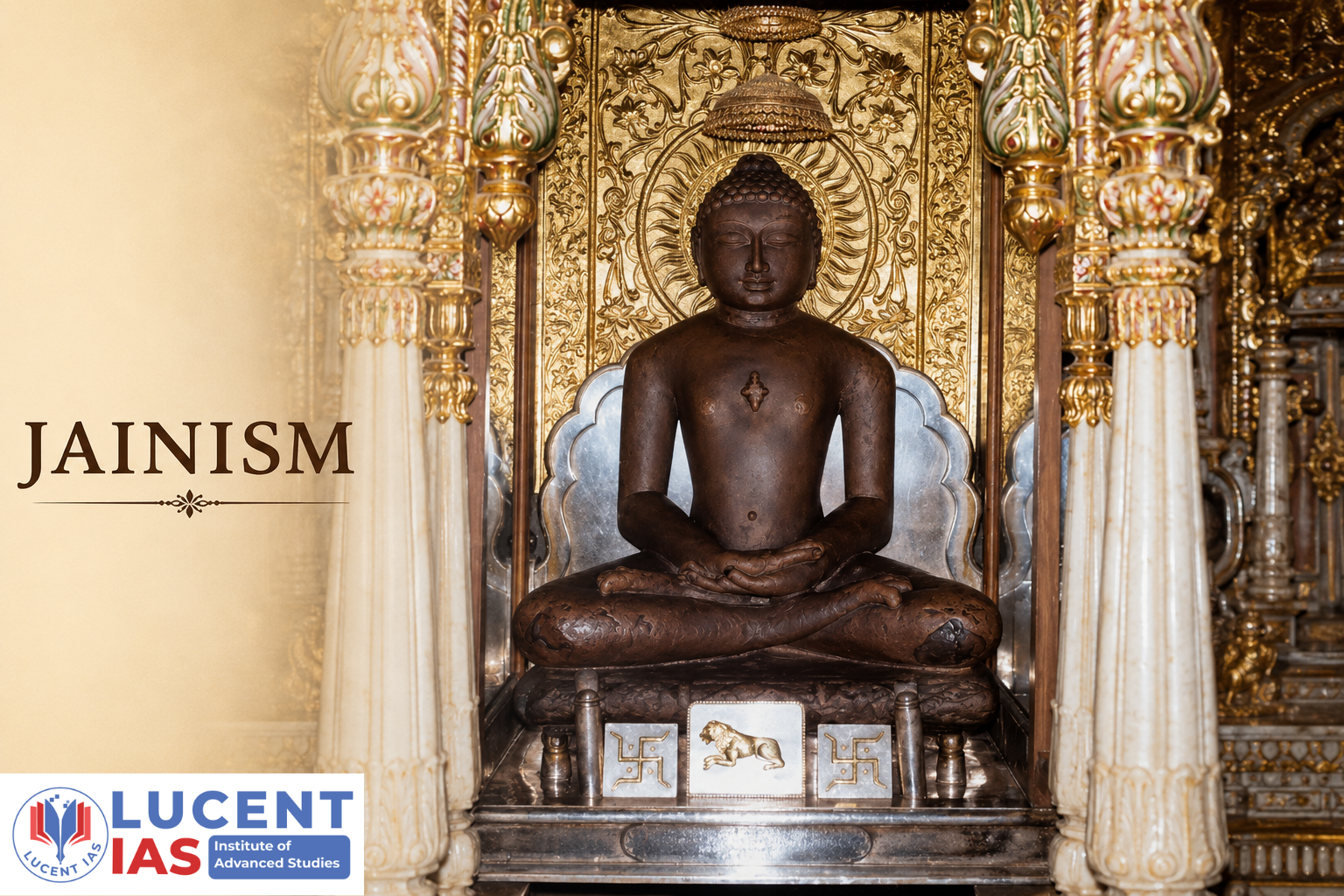
Learn about the rise of Jainism in ancient India, including causes of its rise , teachings, councils, sects and spread. Important for APSC & UPSC ( Prelims & Mains ).
Causes for the Rise of Buddhism and Jainism
Economic and Urban Changes
- The sixth century BCE witnessed the second urbanisation in India.
- Expansion of agriculture led to increased production and economic surplus.
- Growth of trade, crafts, and commerce encouraged the rise of towns and cities such as Rajagriha, Shravasti, Varanasi, and Vaishali.
- New social groups like merchants, artisans, and cultivators emerged as economically powerful classes.
- Despite their economic importance, traders and artisans remained socially inferior within the rigid varna system.
- Brahmanas continued to dominate society and claimed the highest social status.
- The lower social groups and Vaishyas were dissatisfied with the unequal social structure.
Opposition to Brahmanical Dominance
- Brahmanas monopolised religious rituals and ceremonies.
- Elaborate sacrifices and costly rituals became burdensome and irrelevant to changing social conditions.
- Kshatriyas opposed Brahmanical supremacy and searched for alternative religious ideologies.
- Buddhism and Jainism rejected birth-based hierarchy and promoted equality.
Moral and Religious Crisis
- Increasing materialism and social conflicts weakened traditional moral values.
- Society experienced rising violence, greed, and inequality.
- People were attracted to religions that emphasized peace, morality, and self-discipline.
Appeal of Simple and Ethical Teachings
- Buddhism and Jainism promoted:
- Non-violence (Ahimsa)
- Truthfulness
- Simplicity
- Compassion
- Spiritual liberation
- Their teachings were easy to understand and accessible to common people.
Role of Kshatriya Leaders
- Both Gautama Buddha and Mahavira belonged to the Kshatriya varna.
- Their teachings challenged Brahmanical orthodoxy and ritualism.
- Buddhist texts even placed Kshatriyas above Brahmanas in social importance.
Influence of Earlier Thinkers
- Thinkers like Kapila and Makkali Gosala had earlier criticised Vedic practices.
- Buddha and Mahavira successfully transformed these reformist ideas into organised religious movements.
Support from Merchants and Urban Elites
- Wealthy merchants and urban elites strongly supported Buddhism and Jainism.
- They donated generously for monasteries, Sanghas, and religious institutions.
- The support of traders helped these religions spread rapidly across urban centres.
Thus, Buddhism and Jainism emerged as reform movements in response to the socio-economic, religious, and moral changes of sixth century BCE India.They offered a more inclusive, ethical, and egalitarian alternative to Brahmanical traditions.
Jainism
Jainism emerged from the teachings of Vardhamana Mahavira and was initially known as Nirgranthas, meaning “free from bonds.” Although Mahavira is regarded as the real founder of Jainism because he organized its followers into monastic and lay communities, the religion traces its origins to earlier spiritual traditions.
Tirthankaras in Jainism
- Jain tradition believes in the existence of 24 Tirthankaras or spiritual teachers.
- The term Tirthankara means “ford builder,” referring to one who shows the path to cross the cycle of suffering and rebirth.
- Rishabha is considered the first Tirthankara and is mentioned in the Yajur Veda.
- Other important early Tirthankaras included Ajitanatha and Aristanemi.
- Parshvanatha, the 23rd Tirthankara, gave up royal life in Banaras and preached asceticism.
- Mahavira was regarded as the 24th and last Tirthankara.
Doctrines of Jainism
Core Principles of Jainism
- Jainism is based on the principles of:
- Non-violence (Ahimsa)
- Self-discipline
- Renunciation
- It teaches that salvation (moksha) can be achieved only through personal effort and not through divine intervention.
Belief in Soul and Universe
- Jainism believes that all living and non-living beings possess a soul with varying degrees of consciousness.
- Any harm caused to living beings results in suffering for both the victim and the person causing harm.
- Jainism rejects the idea of a supreme creator God.
- According to Jain philosophy:
- The universe has no beginning or end.
- It functions through eternal cycles of progress and decline.
- The universe consists of:
- Jiva (Soul)
- Ajiva (Matter)
Concept of Karma and Moksha
- Karma binds the soul to the cycle of birth and rebirth.
- Liberation (moksha) is attained by removing karma through right conduct and self-discipline.
- Jainism rejects rituals and sacrifices as means to salvation.
Triratnas (Three Jewels)
The path to salvation in Jainism is based on the Triratnas:
1. Right Faith (Samyag Darshana)
- Faith in the teachings of Mahavira and Jain philosophy.
2. Right Knowledge (Samyag Jnana)
- Understanding the true nature of the universe, soul, karma, and reality.
3. Right Conduct (Samyag Charitra)
- Following an ethical and disciplined life through the Five Great Vows.
Five Great Vows (Mahavratas)
- Ahimsa – Non-violence
- Satya – Truthfulness
- Asteya – Non-stealing
- Brahmacharya – Celibacy
- Aparigraha – Non-possession
Opposition to Vedic Rituals
- Mahavira rejected:
- Authority of the Vedas
- Rituals and sacrifices
- Brahmanical orthodoxy
- He emphasized morality, ethics, and self-control instead of rituals.
Social and Economic Ideas
- Jainism opposed caste-based discrimination and promoted equality.
- It stressed that actions, not birth, determine a person’s status.
- Professions involving violence, especially agriculture, were discouraged because they harmed living beings.
- As a result, many Jains became successful traders and merchants.
Position of Women
- Women were admitted into the monastic order.
- However, according to traditional Jain belief, liberation was possible only after rebirth as a man.
Practice of Ahimsa
- Jain monks followed strict non-violence in daily life.
- They adopted practices such as:
- Sweeping the ground before walking
- Covering their mouths to avoid harming tiny insects
Philosophical Concepts
Anekantavada
- Reality has many aspects and cannot be understood from a single viewpoint.
Syadvada
- Truth is conditional and relative to perspective.
Nayavada
- Knowledge is partial and depends on one’s standpoint.
These principles encouraged tolerance and acceptance of different viewpoints.
Jain Scriptures and Councils
- Mahavira’s teachings were initially preserved in the Purvas.
- Later, they were compiled into the 12 Angas during the First Jain Council at Pataliputra.
- The Svetambaras accepted these texts, while the Digambaras believed the original scriptures were lost.
- The Second Jain Council at Vallabhi added the Upangas.
Important Jain Texts
- Acharanga Sutra – Rules and conduct for monks
- Bhagavati Sutra – Detailed explanation of Jain doctrines
Spread of Jainism
Factors Responsible for the Spread of Jainism
- Jainism spread rapidly because of its:
- Simple teachings
- Ethical principles
- Inclusiveness
- Royal patronage
- Mahavira organized a Sangha consisting of:
- Monks
- Nuns
- Lay followers
- The religion was preached in Prakrit, the language of common people, instead of Sanskrit.
- Its simple and practical moral teachings appealed greatly to the masses.
Early Expansion of Jainism
- By the time of Alexander’s invasion, Jain monks had already spread their teachings along the Indus region.
- Jainism gradually expanded across different parts of the Indian subcontinent.
- Important Jain centres emerged at:
- Mathura
- Ujjain
Role of Mahavira’s Disciples
- Mahavira had eleven chief disciples known as Ganadharas.
- Among them, Arya Sudharma survived Mahavira and became the first Thera (chief preceptor) of the Jain order.
- He continued spreading Jain teachings for nearly twenty years after Mahavira’s death.
Contribution of Bhadrabahu
- Later Jain leaders included:
- Sambhutavijaya
- Bhadrabahu
- Bhadrabahu, the sixth Thera, played a crucial role in the spread of Jainism.
- He was a contemporary of Chandragupta Maurya.
Royal Patronage
Jainism received support from several rulers and dynasties, which helped its expansion.
Important Patrons
- Chandragupta Maurya
- Kadambas
- Chalukyas
- Rashtrakutas
Spread in South India
- During a severe famine in the Ganga Valley, Chandragupta Maurya migrated to Shravanabelagola in Karnataka along with Bhadrabahu.
- This migration helped Jainism spread strongly in southern India, especially Karnataka.
Division into Sects
The migration during the famine led to a split within the Jain community. Those who remained in the north under Sthulabahu’s leadership adopted new monastic codes, resulting in the formation of two sects:
Digambaras
- Meaning: “Sky-clad”
- Monks practiced nudity.
- Followed strict and orthodox principles of Jainism.
Svetambaras
- Meaning: “White-clad”
- Monks wore white garments.
- Followed a comparatively liberal interpretation of Jain teachings.
Role of Literature and Organization
- Jain literature written in Ardhamagadhi helped spread Jain philosophy among common people.
- The organized structure of the Jain Sangha strengthened the religion’s growth.
| Council | Place | Year | Chairman | Patron | Major Outcome |
|---|---|---|---|---|---|
| First Jain Council | Pataliputra | 300 BC | Sthulabahu | Chandragupta Maurya | Compilation of the 12 Angas |
| Second Jain Council | Vallabhi | 512 CE | Devaradhi Kshamasramana | — | Final compilation of the 12 Angas and Upangas in written form |
UPSC CSE Prelims PYQ
Q. “Souls are not only the property of animal and plant life, but also of rocks, running water and many other natural objects not looked on as living by other religious sects.” (2023)
The above statement reflects one of the core beliefs of which one of the following religious sects of ancient India?
(a) Buddhism (b) Jainism
(c) Shaivism (d) Vaishnavism
Correct Answer: B
Explanation: Ahimsa, or non-violence, forms the foundation of Jainism. Jains believe that every form of life — including humans, animals, plants, and even elements like air and water — possesses a soul. As a result, Jainism advocates complete respect for all living beings and discourages causing harm to nature or any form of life.
Q. With reference to Indian history, consider the following texts: (2022)
1.Nettipakarana 2. Parishishta Parvan
3.Avadanasataka 4. Trishashtilakshana Mahapurana
Which of the above are Jaina texts?
(a) 1, 2 and 3 (b) 2 and 4 only
(c) 1, 3 and 4 (d) 2, 3 and 4
Correct Answer: B
Explained:
Nettipakarana → A Buddhist text
Parishishta Parvan → A Jaina text written by Hemachandra
Avadanasataka → A Buddhist text
Trishashtilakshana Mahapurana → A famous Jaina text by Jinasena
About Lucent IAS
Lucent IAS is a premier coaching institute in Guwahati, dedicated to empowering APSC aspirants with a result-oriented approach. Recognized as a top destination for APSC Coaching, we offer comprehensive guidance ranging from Foundation Courses and Advanced Mains preparation to our signature Assam-Centric study modules. With expert faculty, small batch sizes for personalized mentoring, and the acclaimed Saadhana Test Series, Lucent IAS is committed to helping you crack the Civil Services Examination.
Publications From LUCENT IAS
- “The Assam Odyssey: The Complete Assam Centric Resource useful for APSC CCE and various other Departmental Examinations. Read More
- InExam PYQ Explained.Read More
- Mains Tattva: The Craft of Answer Writing (GS Paper PYQs). Read More
- Maanchitra – An Illustrative Colour-Coded Informative Map of Assam. Read More
- প্ৰাৰম্ভ (Prarambha). Read More
- অসম ওডিচী – The Assam Odyssey (Assamese Edition). Read More
Start your journey to success today. Visit us at lucentias.com or call +91-6913007777 for more details.