

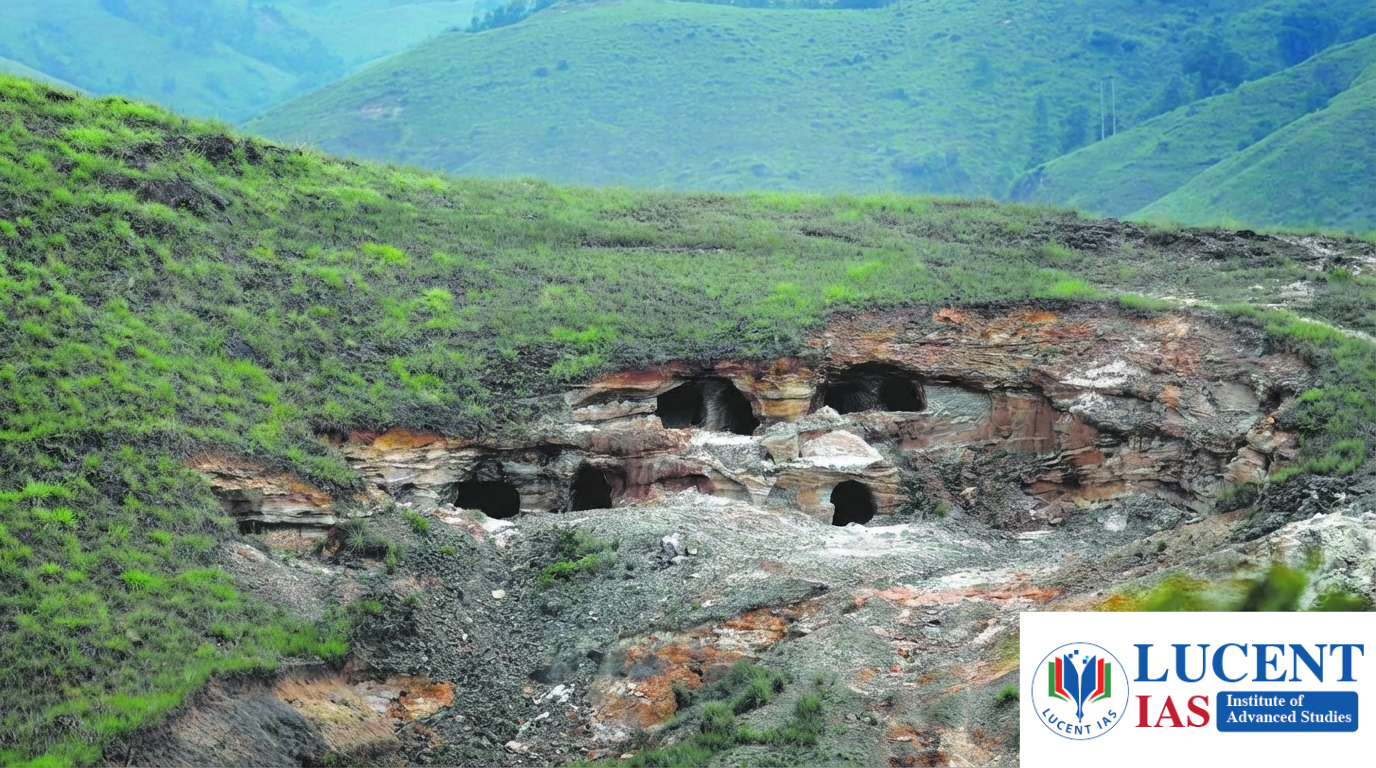
A recent explosion in an illegal rat-hole coal mine in Meghalaya’s East Jaintia Hills has reignited debate on illegal mining, environmental damage, and governance failures. This article explains rat-hole mining, key trends, implications, and the way forward for APSC and UPSC aspirants.
What is Rat-Hole Mining?
Rat-hole mining is a form of illegal mining in which coal is extracted through crude, narrow tunnels about 3–4 feet high, dug horizontally into hillsides or through small vertical pits, often without valid licences, environmental clearance, or adherence to court and tribunal bans.
In Meghalaya, this practice continues despite a ban imposed by the National Green Tribunal (2014) and later upheld by the Supreme Court of India. High demand for low-ash coal and limited livelihood options keep the practice alive.
Key Trends and Data
- Recurring accidents: Multiple fatal incidents have occurred in East Jaintia Hills within short intervals(December 2025- Jan 2026).
- Scale of illegal extraction: Approximately 6 million tonnes of coal are reportedly extracted annually through illegal means.
- Enforcement gaps: RTI data reveals that states like Meghalaya, Jharkhand, and Chhattisgarh ignored ~87% of satellite alerts generated by the Mining Surveillance System (MSS).
- At risk labour: Migrant workers from neighbouring states and countries work in dangerous conditions for daily wages.
- Persistence of illegal mines: As of 2026, there are an estimated 30,000 illegal rat-holes in Meghalaya.
These trends indicate that legal prohibition alone has not been sufficient to eliminate the practice.
Major Implications
1. Human Cost
Rat-hole mining is extremely dangerous. Tunnel collapses, flooding, and gas explosions are common due to lack of safety infrastructure.
Example: Thangsku blast killed 18 workers
Illegal mining leads to:
- Acid mine drainage contaminating rivers and groundwater.
- Destruction of aquatic ecosystems.
- Deforestation and soil erosion in ecologically fragile hill regions.
Example: Kopili River turned acidic (pH ~2–3), destroying aquatic life.
Illegal mining bypasses royalties and taxation, resulting in significant losses to state and central governments. The informal nature of operations also fuels black-market coal trade.
Example: 2025 CAG flagged ₹784 crore losses from illegal mining in Uttar Pradesh.
Illegal coal extraction and transport are often linked to networks that influence local administration and law enforcement, making regulation difficult.
Example: Activist Agnes Kharshiing attacked for exposing illegal coal transport (2025).
Unregulated excavation leads to land subsidence, landscape degradation, and long-term environmental vulnerability.
Example: Jharia saw house collapses due to illegal scavenging (2025).
Why Control Remains Difficult
Several structural factors contribute to the persistence of illegal mining:
1. Politico-criminal nexus:Influence and local networks sometimes shield illegal operators from strict action.
Example: Reports by the Justice Katakey Committee (2025) are often ignored.
2. Remote and difficult terrain: Forest cover and hilly terrain make surveillance and enforcement challenging.
Example: Thangsku site’s remoteness delayed NDRF response.
3. Economic dependence: Coal mining provides higher wages compared to agriculture or daily labour, creating local dependence.
4. Weak follow-up on technology inputs: Mining Surveillance System alerts rarely lead to prosecutions due to poor ground verification.
5. Legal and administrative loopholes: Disputes regarding “pre-ban coal stock” and transport permits create grey areas that are sometimes misused.
Steps Taken by the Government
Legislative Action: The Draft MMDR Amendment Bill, 2026 proposes harsher penalties and tags some illegal mining as security threats.
Surveillance: The Mining Surveillance System (MSS) provides satellite monitoring within 500 m of leases.
Oversight: The Justice Katakey Committee continues to oversee restoration and illegal transport in the Northeast.
Relief Measures: Ex-gratia relief of ₹2 lakh (PMNRF) + ₹3 lakh (State) was announced for families of the 2026 blast victims.
Way Forward
1. Strengthening Enforcement through Technology: Satellite-based monitoring systems such as the Mine Surveillance System (MSS) should be integrated with a time-bound response mechanism. Mandating action within 48 hours and fixing institutional accountability can significantly improve enforcement against illegal mining.
2. Promoting Scientific and Regulated Mining: The transition from unscientific and hazardous mining practices to scientifically managed, regulated methods must be accelerated. This would ensure worker safety, environmental protection, and sustainable resource extraction in line with judicial and policy guidelines.
3. Diversifying Livelihood Opportunities: Reducing dependence on coal requires scaling up alternative livelihoods such as eco-tourism, agro-based industries, and bio-economy initiatives. Skill development and targeted rural employment programmes can support this transition.
4. Improving Transparency in Mineral Transport: Technology-enabled mechanisms such as IoT-based weighbridges, GPS tracking of transport vehicles, and mandatory digital transit passes should be implemented to monitor the movement of minerals and prevent leakages in the supply chain.
5. Institutional and Judicial Reforms: Establishing special environmental courts or fast-track mechanisms can ensure timely disposal of mining-related cases, strengthening deterrence against illegal mining networks and improving regulatory effectiveness.
Conclusion
The rat-hole mining crisis highlights the complex intersection of poverty, governance challenges, environmental degradation, and resource demand. Addressing the issue requires not just bans and enforcement, but a comprehensive policy approach that balances livelihood security, ecological sustainability, and rule of law.
LUCENT IAS Mains Practice Question
Q. What is Rat Hole Mining? Discuss the socio economic, governance and environmental implications of persistence of Rat Hole Mining and suggest measures to address the issue. (Write in 250 Words) 15
About Lucent IAS
Lucent IAS is a premier coaching institute in Guwahati, dedicated to empowering APSC aspirants with a result-oriented approach. Recognized as a top destination for APSC Coaching, we offer comprehensive guidance ranging from Foundation Courses and Advanced Mains preparation to our signature Assam-Centric study modules. With expert faculty, small batch sizes for personalized mentoring, and the acclaimed Saadhana Test Series, Lucent IAS is committed to helping you crack the Civil Services Examination.
Publications From LUCENT IAS
- “The Assam Odyssey: The Complete Assam Centric Resource useful for APSC CCE and various other Departmental Examinations. Read More
- InExam PYQ Explained.Read More
- Mains Tattva: The Craft of Answer Writing (GS Paper PYQs). Read More
- Maanchitra – An Illustrative Colour-Coded Informative Map of Assam. Read More
- প্ৰাৰম্ভ (Prarambha). Read More
- অসম ওডিচী – The Assam Odyssey (Assamese Edition). Read More
Start your journey to success today. Visit us at lucentias.com or call +91-6913007777 for more details.