

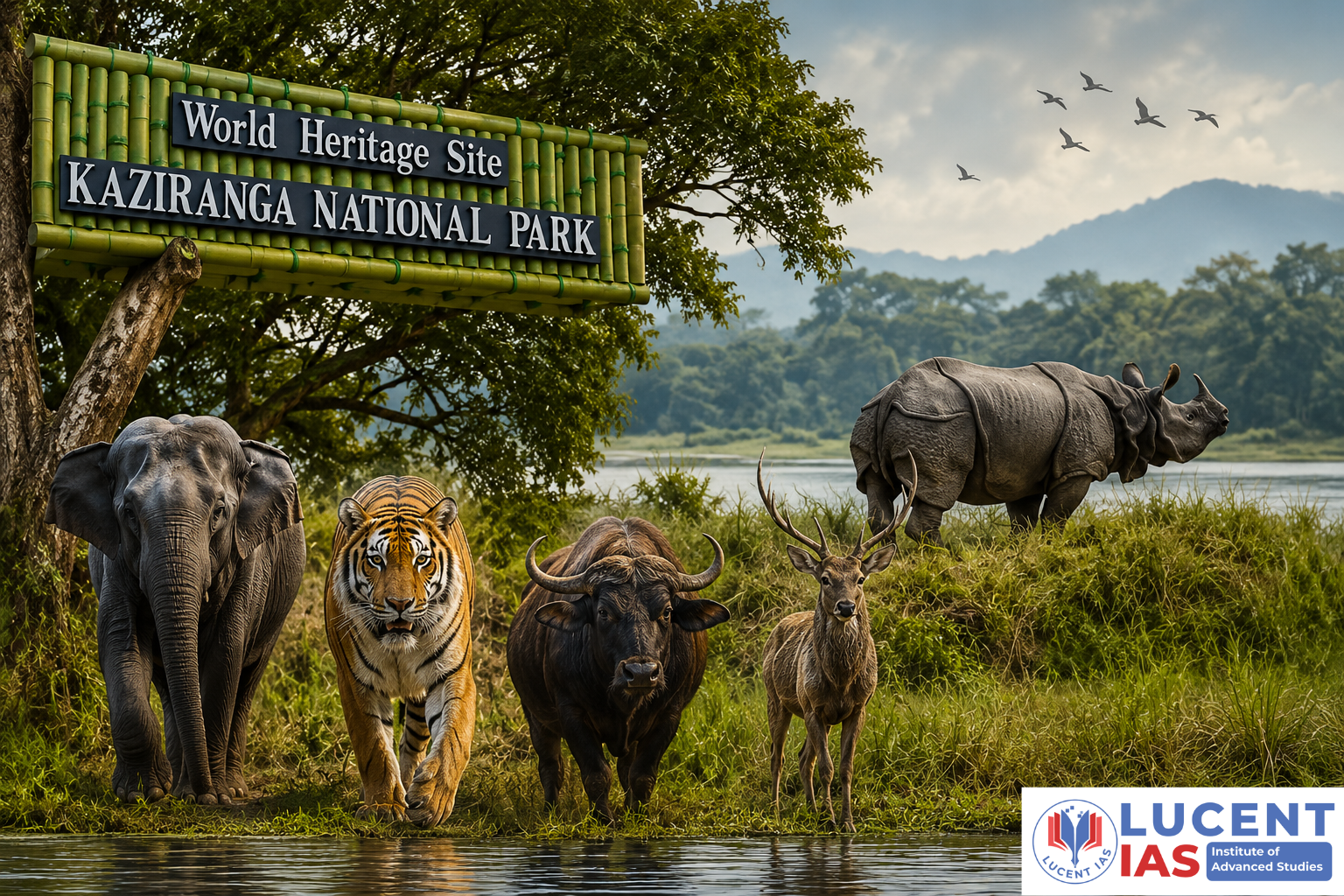
Explore Kaziranga National Park, Assam’s UNESCO World Heritage Site, home to the iconic one-horned rhinoceros, rich floodplain ecosystems, migratory birds, Bengal tigers, and the latest 2026 wildlife discoveries including the first confirmed gharial sighting. Important for APSC ( Prelims & Mains ).
KAZIRANGA NATIONAL PARK
Kaziranga National Park in Assam is a globally recognized UNESCO World Heritage Site and Tiger Reserve. Positioned dynamically in the Eastern Himalaya biodiversity hotspot, it functions as India’s premier riverine flood refuge for endangered megafauna and migratory birds.
Districts: Original KNP falls in Nagaon and Golaght districts, a small part of it also falls Karbi Anglong (E). Newly added area of Kaziranga (10th addition) is in Biswanath district.
Subdivisions: Situated within the Kaliabor subdivision (Nagaon), Bokajan subdivision (Karbi Anglong region), and Bokakhat subdivision (Golaghat; Park Headquarters).
Physical Boundaries: Hemmed by the Brahmaputra River on the North/East and the Karbi Anglong (Mikir) Hills on the South.
Transit Infrastructure: National Highway 37 (now NH 715) cuts directly through the park area.
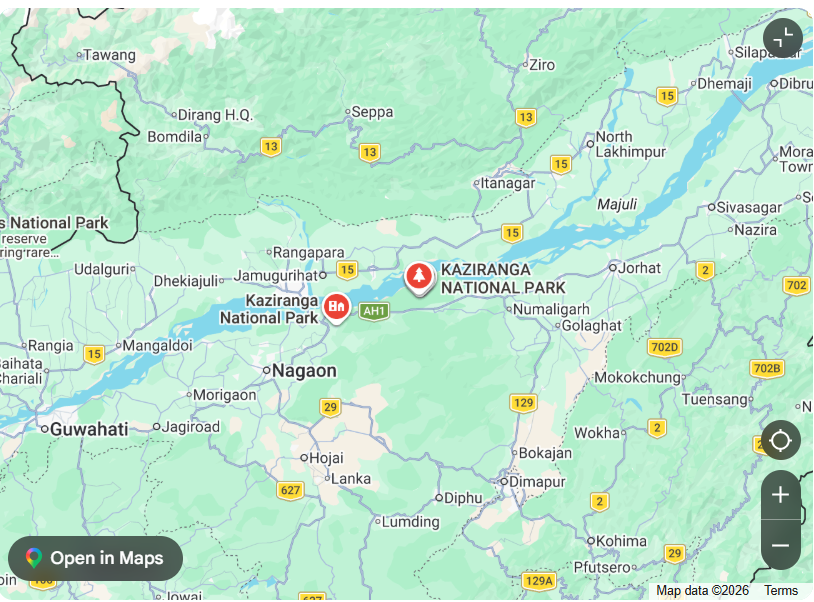
Kaziranga National Park: Administrative & Safari Ranges
Kaziranga National park is divided into five distinct administrative ranges for management and ecotourism:
Central Range (Kohora Zone): Located at Kohora town; serves as the main tourist hub and core operational area.
Western Range (Bagori Zone): Located at Bagori; highly marshy with high concentrations of open wetlands, offering the closest sightings of large herbivores like rhinos.
Eastern Range (Agaratoli Zone): Located at Agaratoli; heavily forested with swampy areas near the Brahmaputra River, famous for deep-woods species and birdwatching.
BurapaharRange (Ghorakati Zone): Located at Ghorakati village; features hilly terrain and thick woodlands, notable for trekking and primate sightings.
Northern Range (Biswanath Zone): Dominated by the aquatic territories along the northern bank of the Brahmaputra River.
KAZIRANGA NATIONAL PARK Hydrology & River Systems
Four Major Rivers: Crisscrossed by a network of four primary rivers:
- Brahmaputra: Forms the northern and eastern boundaries; deposits rich Himalayan alluvial soil.
- Diphlu(Difalu): Flows directly through the core/critical national park area.
- Mora Diphlu: Forges and runs along the southern boundary of the park.
- Mora Dhansiri: Intersects the floodplains to provide vital aquatic habitats.
Local Water Bodies: Characterized by numerous small, semi-permanent shallow wetlands locally called Beels and closed oxbow lakes.
Vegetation & Landscape
The Floodplain
- Untouched: The largest undisturbed stretch of the Brahmaputra Valley.
The Flora Mix
- Elephant Grass: Giant tall grasslands growing up to 5 meters.
- Habitat Mosaic: Marshlands, dense woodlands, and tropical forests.
Ecosystem Drivers
- The Cycle: 2/3 of grasslands rely on annual flooding and controlled burning.
Geomorphic Shifts
- River Erosion: High sedimentation constantly reshapes the land.
- “Char” Transition: Sandbars continuously shift from grass to dense woodland.
The “Big Five” & Species Population
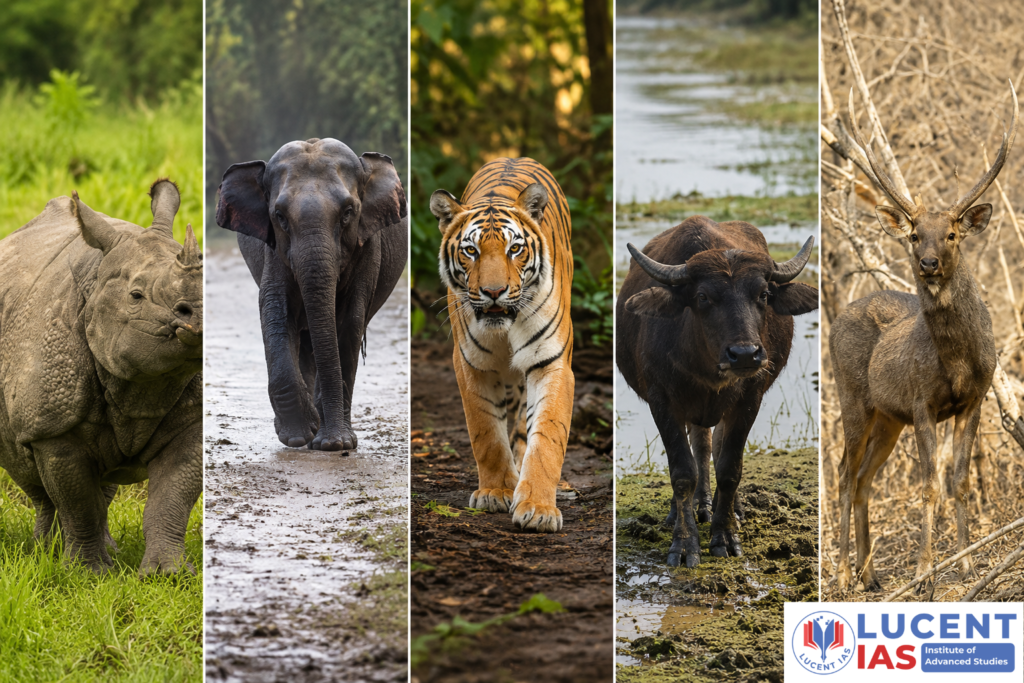
- The Big Five: One-horned Rhino, Indian Elephant, Royal Bengal Tiger, Swamp Deer (Eastern), and Asiatic Water Buffalo.
- Rhino Concentration: Holds two-thirds of the world’s population of the Great Indian One-horned Rhinoceros (2,413 / 2018 Census).
- Tiger Density: Hosts India’s 3rd highest population (103 / 2014 Census) behind Jim Corbett (1st) and Bandipur (2nd).
- Primate Wealth: Habitat for 9 out of 14 primate species found in the subcontinent (including Hoolock Gibbon, Capped Langur).
- Aquatic Refuge: Closed oxbow lakes harbour the Endangered Ganges River Dolphin.
Legal Status Timeline
- 1905: Created as Kaziranga Proposed Reserve Forest (232 sq. km) via Mary Curzon and Viceroy Lord Curzon.
- 1916: Redesignated as Kaziranga Game Sanctuary (hunting banned later in 1938).
- 1950: Renamed Kaziranga Wildlife Sanctuary by forest conservationist P.D. Stracey to drop hunting connotations.
- 1954: Passed Assam (Rhinoceros) Bill, enforcing heavy penal consequences for poaching.
- 1974: Granted official National Park status (430 sq. km).
- 1985: Inscribed as a UNESCO World Heritage Site (Criteria ix and x).
- 2007: Formally declared a Tiger Reserve (Core: ~482 aq. km| Buffer: ~573 sq. km)
2026 Ecological Milestones in Kaziranga National Park
- Flyway Node: Sits at the critical geographical intersection of the Australasia and Indo-Asian migratory bird flyways; designated as an Important Bird Area (IBA) by BirdLife International.
- Waterbird Count 2026: Recorded 105,540 individual waterbirds spanning 107 species across 166 wetlands.
- Most Abundant Birds: Bar-headed Goose, Northern Pintail, and Lesser Whistling Duck.
- Smew Bird: Documented first-ever historical sighting of this avian species inside the reserve.
- Gharial Record (May 8, 2026): First-ever confirmed sighting of a Critically Endangered Gharial inside the park (spotted in the Burhapahar Range near Dipholu Camp).
- Turtle Telemetry: Release of India’s first satellite-tagged Ganges soft-shell turtle (Nilssoniagangetica, Endangered) directly into the reserve’s waters.
About Lucent IAS
Lucent IAS is a premier coaching institute in Guwahati, dedicated to empowering APSC aspirants with a result-oriented approach. Recognized as a top destination for APSC Coaching, we offer comprehensive guidance ranging from Foundation Courses and Advanced Mains preparation to our signature Assam-Centric study modules. With expert faculty, small batch sizes for personalized mentoring, and the acclaimed Saadhana Test Series, Lucent IAS is committed to helping you crack the Civil Services Examination.
Publications From LUCENT IAS
- “The Assam Odyssey: The Complete Assam Centric Resource useful for APSC CCE and various other Departmental Examinations. Read More
- InExam PYQ Explained.Read More
- Mains Tattva: The Craft of Answer Writing (GS Paper PYQs). Read More
- Maanchitra – An Illustrative Colour-Coded Informative Map of Assam. Read More
- প্ৰাৰম্ভ (Prarambha). Read More
- অসম ওডিচী – The Assam Odyssey (Assamese Edition). Read More
Start your journey to success today. Visit us at lucentias.com or call +91-6913007777 for more details.