

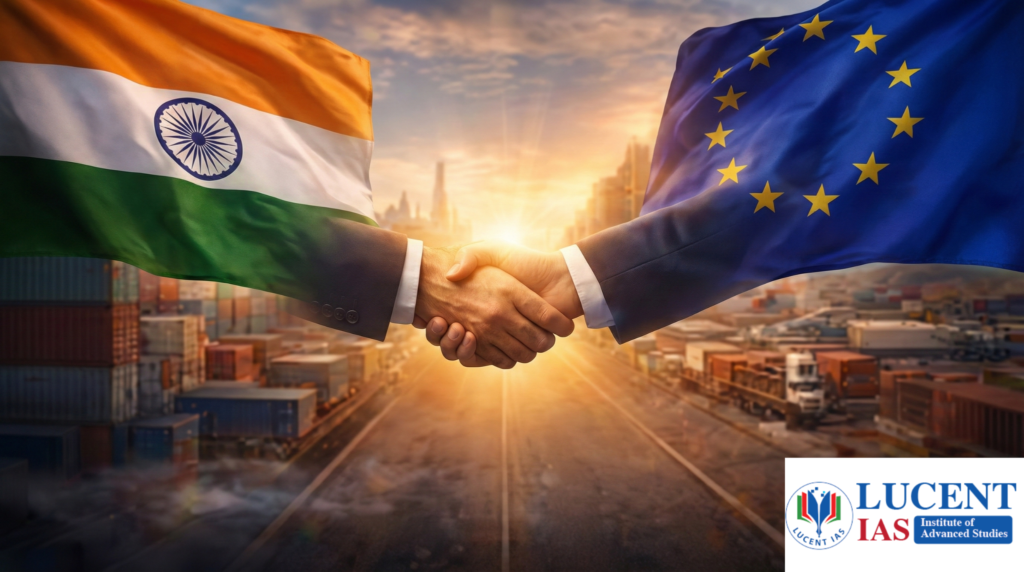
On January 27, 2026, the 16th India–EU Summit in New Delhi culminated in the political conclusion of the India–European Union Free Trade Agreement. Termed the “Mother of All Deals,” this pact marks a tectonic shift from India’s traditional trade skepticism to a “strategic convergence” with its largest trading partner.
Background / History
- Negotiations initiated in 2007, stalled for years, and revived in 2022.
- Politically concluded on 27 January 2026 after prolonged negotiations.
- Post-conclusion, the agreement requires ratification by: Indian Parliament, European Parliament and EU Council.
- With this pact, the EU becomes India’s 22nd FTA partner.
Significance of the India–EU FTA
1. Unprecedented Market Access for India
- Over 99% of Indian exports (by value) receive zero or reduced tariffs in the EU.
- Access to the EU Single Market, one of the world’s most regulated and high- value markets.
2. Global Strategic Importance
- Termed the “mother of all deals” by leaders, underlining its scale and geopolitical value.
- Covers a market of ~2 billion people and ~25% of global GDP, making it one of the largest FTAs globally.
3. Boost to Labour-Intensive Sector
Major beneficiaries include:
- Textiles and apparel
- Leather and footwear
- Marine products
- Gems & jewellery
- Handicrafts
- Engineering goods
Immediate tariff elimination enhances employment generation and export competitiveness.
4. Agriculture and Processed Food Export
- Improved EU access for:
—Tea, coffee, spices
— Fresh fruits and vegetables
— Processed foods
- Strengthens rural incomes, MSME participation, and India’s role as a reliable agri-exporter.
5. Automobile Sector Liberalisation
- Reciprocal, quota-based tariff reduction
- Enables:
— Controlled access for EU premium automobiles in India.
— Expansion of Make in India, local manufacturing, and future exports from India to the EU.
6. Services Trade and Skilled Mobility
- India gains access to 144 EU sub-sectors (IT/ITeS, professional services, education, etc.)
- EU gains access to 102 Indian sub-sectors.
- Strengthens India’s position in global services value chains.
7. Trade Diversification & Supply Chain Resilience
- Reduces over-dependence on any single market amid global trade uncertainties.
- Enhances resilient and trusted supply chains, especially in a fragmented global order.
Implications for the Indian Tea Sector
Industry Viewpoint
- The Tea Association of India (TAI) has welcomed the India–EU FTA as a positive step for enhancing India’s competitiveness in global markets, particularly in agriculture, processed foods, and tea.
- At the same time, TAI has flagged persistent regulatory challenges arising from EU norms on Maximum Residue Limits (MRLs), food safety, traceability, packaging, and labelling.
Specific Gains for the Tea Sector
- Import duties on black tea and most green tea categories were already nil.
- The FTA is expected to eliminate duties on green tea imports of less than 3 kg, further boosting India’s export potential.
- The industry expects stronger commitments on:
— Regulatory transparency
— Science-based standards
— Advance consultations before introduction of new EU measures.
Concerns and Conditions
- EU regulations on MRLs and compliance standards remain a key hurdle.
- Without domestic alignment, these standards could limit effective market access despite tariff concession
Tea Export Snapshot (India–EU)
- India exports approximately 19–21 million kilograms of tea annually to EU countries.
- Germany and Poland together account for a substantial share of India’s tea exports to the EU.
- These countries function as key entry points and redistribution hubs within the European market, amplifying their strategic importance for Indian exporters.
About the European Union (EU)
- The European Union (EU) is a unique economic and political union of 27 European countries, formed to promote peace, stability, economic integration, and shared democratic values through supranational governance.
Historical Evolution
1951: Began as the European Coal and Steel Community (ECSC) with 6 founding members, aimed at preventing conflict through economic integration.
1957: Treaty of Rome established the European Economic Community (EEC), expanding cooperation beyond coal and steel.
2009: Lisbon Treaty created the present institutional architecture, strengthening democratic accountability and external action.
Membership
- 27 member states as of 2026.
- The United Kingdom exited in 2020 through Brexit, marking the first withdrawal from the EU.
Key EU Institutions
1. European Commission
- Acts as the executive arm of the EU.
- Proposes legislation, enforces EU law, manages policies and the EU budget.
2. European Parliament
- Directly elected by EU citizens.
- Shares legislative and budgetary powers; exercises democratic oversight.
3. European Council
- Composed of heads of state or government.
- Sets the overall political direction and strategic priorities of the EU.
4. Court of Justice of the European Union
- Ensures uniform interpretation and application of EU law across member states.
5. European Central Bank
- Manages the euro and formulates monetary policy for the Eurozone.
- Ensures price stability and financial system integrity.
Challenges of India–EU Free Trade Agreement
1. High EU Standards: Stringent environmental and labour norms raise compliance costs; act as non-tariff barriers for Indian exporters.
2. Carbon Border Adjustment Mechanism(CBAM) Impact: EU’s carbon tax on steel, cement, aluminium may reduce India’s export competitiveness.
3. Sensitive Sector Tariffs: Duty cuts on automobiles, wines, spirits, dairy may hurt domestic industries and MSMEs.
4. Public Procurement: EU demand for market access conflicts with India’s local-preference policies.
5. Regulatory Compliance: Meeting EU Sanitary and Phytosanitary (SPS) standards is difficult for small exporters.
Way Forward
- Phased Liberalisation: Gradual tariff cuts with long transition periods for sensitive sectors.
- Safeguards: Use carve-outs and trade-remedy measures to protect MSMEs and farmers.
- Make in India & Production Linked Incentives : Leverage FTA for manufacturing, technology transfer, and value-chain integration.
- Digital Sovereignty: Balance data flows with privacy and national security concerns.
- Intellectual Property Rights & CBAM Balance: Protect generics; seek climate cooperation and transitional relief on CBAM.
LUCENT IAS APSC UPSC Mains Practice Question
Q. The recently concluded India–EU Free Trade Agreement (2026) is more than a commercial pact; it is a ‘strategic insurance policy’ in an era of weaponized trade and fragmented global supply chains. Critically analyze the significance of this agreement in the context of the current global trade war and India’s ‘Strategic Autonomy’.” (250 Words | 15 Marks)
About Lucent IAS
Lucent IAS is a premier coaching institute in Guwahati, dedicated to empowering APSC aspirants with a result-oriented approach. Recognized as a top destination for APSC Coaching, we offer comprehensive guidance ranging from Foundation Courses and Advanced Mains preparation to our signature Assam-Centric study modules. With expert faculty, small batch sizes for personalized mentoring, and the acclaimed Saadhana Test Series, Lucent IAS is committed to helping you crack the Civil Services Examination.
Start your journey to success today. Visit us at lucentias.com or call +91-6913007777 for more details.