

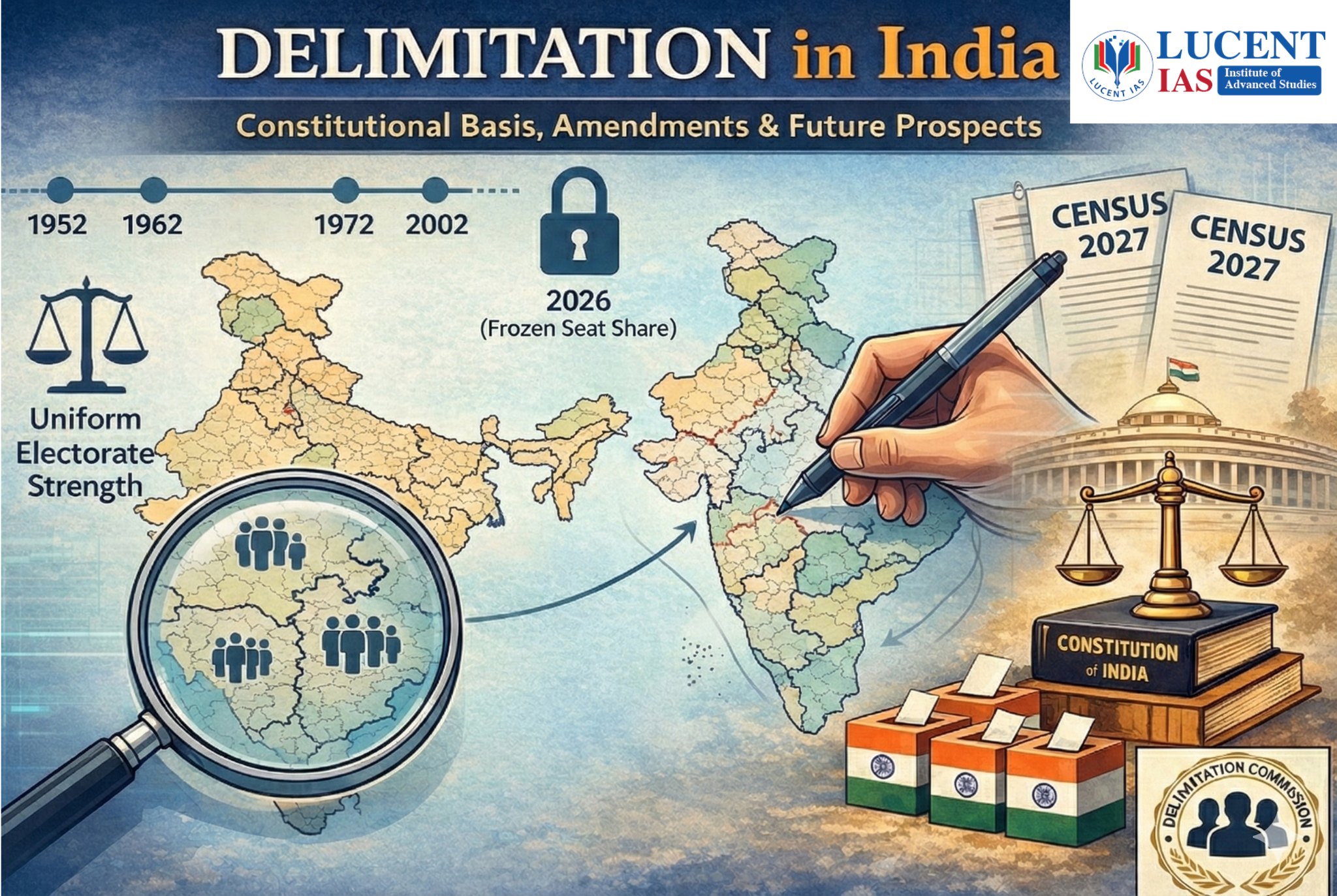
Understand delimitation in India for UPSC and APSC ( Prelims/ Mains).Learn about Articles 81, 82, 170, Constitutional Amendments (42nd, 84th, 87th), Delimitation Commission, and the post-2026 scenario.
Constitutional Provisions Related to Delimitation
The Constitution provides the legal foundation for delimitation under:
- Article 81 – Allocation of seats in the Lok Sabha among states.
- Article 82 – Readjustment of Lok Sabha constituencies after every Census.
- Article 170 – Readjustment of seats in State Legislative Assemblies after every Census.
History of Delimitation Exercises in India
Delimitation has been undertaken four times:
- 1952
- 1962
- 1972
- 2002
The Post-1972 Concern
After the delimitation of 1972, it was the thought that any further delimitation would alter share of states in lok sabba detrimentally affecting the southern States which were successful in implementing population control programmes as these seats could be appropriated by the states which witnessed exponential population growth.
Constitutional Amendments and Freeze on Delimitation
- 42nd Constitutional Amendment Act, 1976 stalled any further delimitation till the year 2000, and share of States in Lok Sabha was frozen till 2026.
- Once the probibition period got over in 2000, Parliament passed 84th CAA 2001 to provide for fresh delimitation on the basis of 1991 census figures.
- Delimitation Act, 2002: Parliament passed the Delimitation Act -constituted a three-member Delimitation Commission;Empowered it to redraw constituency boundaries.
- 87th Constitutional Amendment Act, 2003: Allowed use of 2001 Census data instead of 1991 Census.
The Post-2026 Scenario: What Lies Ahead?
- The latest delimitation was carried on without altering the seat share of states thereby implying that delimitation was essentially carried out to ensure uniform electorate based in all constituencies within every state.
- As per the 84th Constitutional Amendment: Fresh delimitation is not mandatory until the first Census after 2026.
- India to conduct its first digital Census in two phases with caste enumeration after 17 years, reference date set for March 1, 2027.
Delimitation Commission:
- Statutory body(Extra Constitutional body)
- When placed before the Parliament or Sate Assembly, the orders of Delimitation Commission cannot be changed.
- The orders of Delimitation Commission cannot be challenged in a court of law.
- Members:
a. Retired Supreme Court Judge
b. Chief Election Commissioner
c. State Election Commissioner
APSC Previous Year Question
APSC CCE 2023
Q. Consider the following statements regarding the Delimitation Commission of India:
I. The Delimitation Commission is appointed by the President of India and works in collaboration with the President of India.
II. Article 82 of the Constitution of India states that the Parliament is required by law to enact a Delimitation Act following each Census.
III. The first Delimitation exercise in post-independent India was held in 1952 as per 1951 Census.
IV. The present delimitation of parliamentary constituencies has been done on the basis of the 2001 Census figures under the provisions of the Delimitation Act, 2002
Select the correct statement/ statements using the codes given below.
(A) I only
(B) I and II only
(C) I, II and III only
(D) I, II, III and IV
Correct Answer: D
Explanation: All Statements are accurate.
The Delimitation Commission, appointed by the President of India, is a high-powered body whose orders have the force of law and cannot be challenged in court. Its decisions take effect on a date specified by the President and are made in collaboration with the Election Commission of India.
Under Article 82 of the Constitution, Parliament enacts a Delimitation Act after each census, leading to the formation of a Delimitation Commission. The first delimitation post-independence occurred in 1952, based on the 1951 Census. The latest delimitation, based on the 2001 Census, was carried out under the 2002 Delimitation Act, which froze the number of seats in the Lok Sabha and State Assemblies until the first census after 2026.
About Lucent IAS
Lucent IAS is a premier coaching institute in Guwahati, dedicated to empowering APSC aspirants with a result-oriented approach. Recognized as a top destination for APSC Coaching, we offer comprehensive guidance ranging from Foundation Courses and Advanced Mains preparation to our signature Assam-Centric study modules. With expert faculty, small batch sizes for personalized mentoring, and the acclaimed Saadhana Test Series, Lucent IAS is committed to helping you crack the Civil Services Examination.
Publications From LUCENT IAS
- “The Assam Odyssey: The Complete Assam Centric Resource useful for APSC CCE and various other Departmental Examinations. Read More
- InExam PYQ Explained.Read More
- Mains Tattva: The Craft of Answer Writing (GS Paper PYQs). Read More
- Maanchitra – An Illustrative Colour-Coded Informative Map of Assam. Read More
- প্ৰাৰম্ভ (Prarambha). Read More
- অসম ওডিচী – The Assam Odyssey (Assamese Edition). Read More
Start your journey to success today. Visit us at lucentias.com or call +91-6913007777 for more details.