

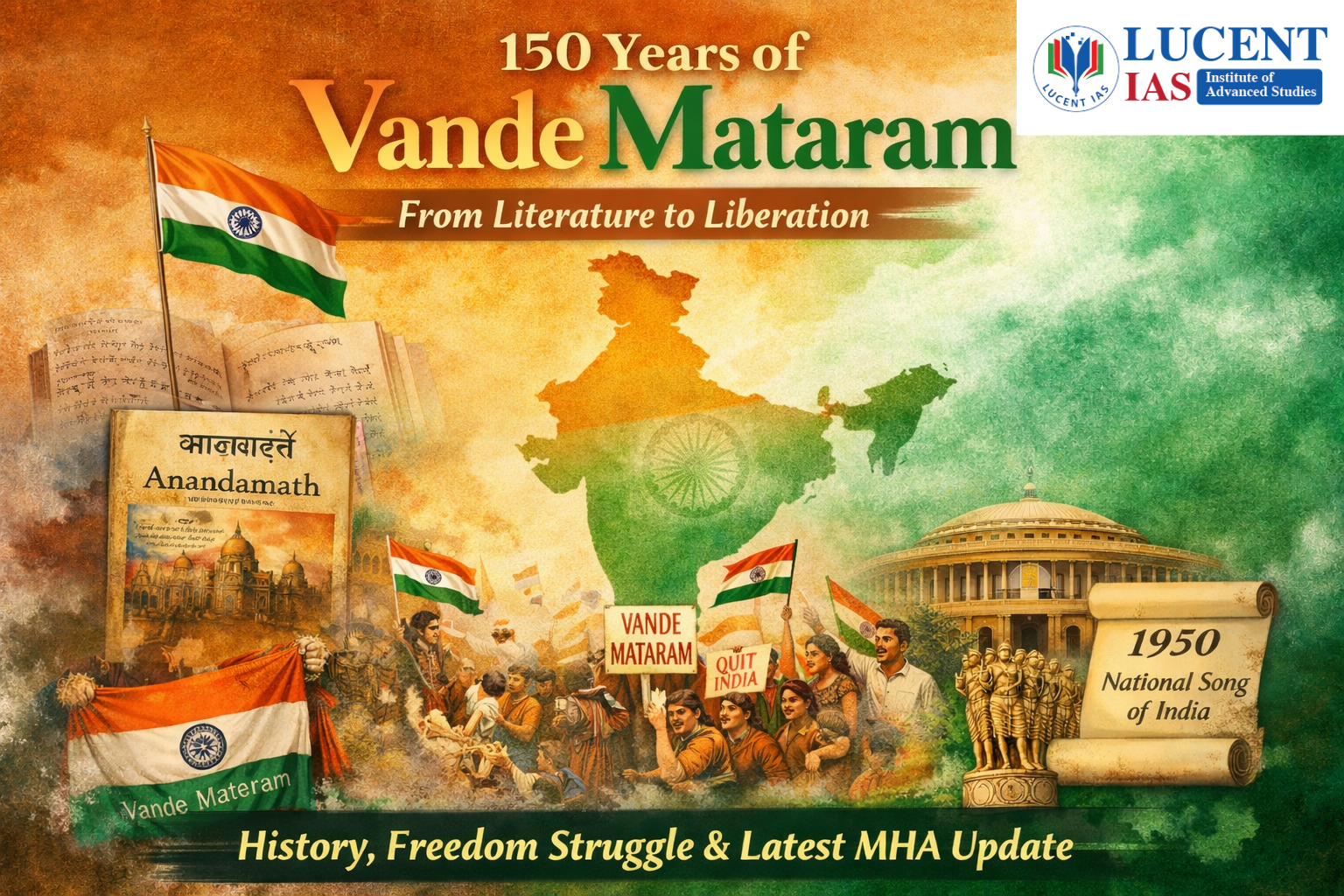
The Ministry of Home Affairs has issued comprehensive guidelines on the National Song Vande Mataram, mandating the complete six-stanza official version be sung at schools and government events, and directing that Vande Mataram should be sung first, followed by Jana Gana Mana, when both are included in a programme. Read More Below.
Key Guidelines
Order of Performance
- When both Vande Mataram and the National Anthem (Jana Gana Mana) are part of a programme, the National Song must be performed first, followed by the National Anthem.
Standing Protocol
- The audience is required to stand at attention when the official version of Vande Mataram—approximately 3 minutes and 10 seconds long—is sung or played.
- Printed lyrics may be circulated for uniform participation.
Exception
- Standing is not mandatory if the song is played as part of a newsreel, documentary, or recorded background segment.
Occasions for Singing
The official version of the National Song shall be sung on:
- Arrival of the President at government/public functions.
- Unfurling of the National Flag (Tricolour).
- Speeches of Governors.
- Cultural and ceremonial functions (other than parades).
- Other significant official events.
Basic Facts
- Composed by Bankim Chandra Chatterjee in 1875.
- First published in Bangadarshan on 7 November 1875.
- Later included in his novel Anandamath (published 1882).
- First sung at the 1896 Congress Session by Rabindranath Tagore.
- Translates to: “Mother, I Bow to Thee.”
Role in Freedom Struggle
Became a Political Slogan (1905 onwards)
- First used politically on 7 August 1905 during anti-partition protests in Calcutta.
- Became the emotional core of the Swadeshi Movement.
- Echoed across Bengal, Punjab, Maharashtra, Tamil Nadu and beyond.
Spread of Nationalism
- English newspaper Bande Mataram launched in 1906 by Bipin Chandra Pal, later joined by Sri Aurobindo Gosh.
- Processions, strikes, and court gatherings resounded with the slogan.
- Workers, students, and leaders used it before arrests and protests.
Impact on Indian Revolutionaries Abroad
- In 1907, Madam Bhikaji Cama raised the tricolour flag for the first-time outside India in Stuttgart, Berlin. The words Vande Mataram were written on the flag.
- On 17 August 1909, when Madan Lal Dhignra was hanged in England, his last words before he went to the gallows were Bande Mataram.
- In 1909, Indian patriots in Paris undertook the publication of a magazine called Bande Mataram from Geneva.
- In October 1912, when Gopal Krishna Gokhale arrived in Cape Town, South Africa, he was welcomed by a grand procession accompanied by cries of ‘Vande Mataram.’
National Status (1950)
- On 24 January 1950, Dr.Rajendra Prasad declared:
- Jana Gana Mana – National Anthem
- Vande Mataram – National Song
Commemorating 150 Years of Vande Mataram
- The Government of India will commemorate this in four phases.

Yearlong Activities
- National inaugural event at Indira Gandhi Stadium, Delhi (7 Nov 2025).
- Commemorative stamp and coin release.
- Exhibitions, short films, seminars.
- Cultural programmes across India and abroad.
- Tree plantation drives (Vande Mataram: Salute to Mother Earth).
- Patriotic murals and LED displays at public places.
- 25 short films on history and Bankim Chandra Chatterjee’s life.
- To channelise the energy of patriotism, the Vande Mataram Campaign and thHar Ghar Tiranga Campaign rbe celebrated simultaneously,
LUCENT IAS Prelims Practice Questions
Q. With reference to Vande Mataram, consider the following statements:
- It was first published in the novel Anandamath in 1882.
- It was first sung at the 1896 session of the Indian National Congress.
- It was adopted as the National Anthem of India in 1950.
Which of the statements given above is/are correct?
(a) 1 and 2 only
(b) 2 only
(c) 2 and 3 only
(d) 1, 2 and 3
Answer: b
Explanation:
- The song was first published in 1875 and later included in Anandamath (1882).
- It was first sung at the 1896 Congress session by Rabindranath Tagore.
- It was adopted as the National Song, not the National Anthem, in 1950.
Q. “Vande Mataram” became a powerful political slogan during which of the following events?
(a) Non-Cooperation Movement
(b) Swadeshi Movement following the Partition of Bengal (1905)
(c) Civil Disobedience Movement
(d) Quit India Movement
Answer: (b)
Explanation:
The slogan gained mass political significance on 7 August 1905 during protests against the Partition of Bengal and became the emotional core of the Swadeshi Movement.
About Lucent IAS
Lucent IAS is a premier coaching institute in Guwahati, dedicated to empowering APSC aspirants with a result-oriented approach. Recognized as a top destination for APSC Coaching, we offer comprehensive guidance ranging from Foundation Courses and Advanced Mains preparation to our signature Assam-Centric study modules. With expert faculty, small batch sizes for personalized mentoring, and the acclaimed Saadhana Test Series, Lucent IAS is committed to helping you crack the Civil Services Examination.
Publications From LUCENT IAS
- “The Assam Odyssey: The Complete Assam Centric Resource useful for APSC CCE and various other Departmental Examinations. Read More
- InExam PYQ Explained.Read More
- Mains Tattva: The Craft of Answer Writing (GS Paper PYQs). Read More
- Maanchitra – An Illustrative Colour-Coded Informative Map of Assam. Read More
- প্ৰাৰম্ভ (Prarambha). Read More
- অসম ওডিচী – The Assam Odyssey (Assamese Edition). Read More
Start your journey to success today. Visit us at lucentias.com or call +91-6913007777 for more details.