

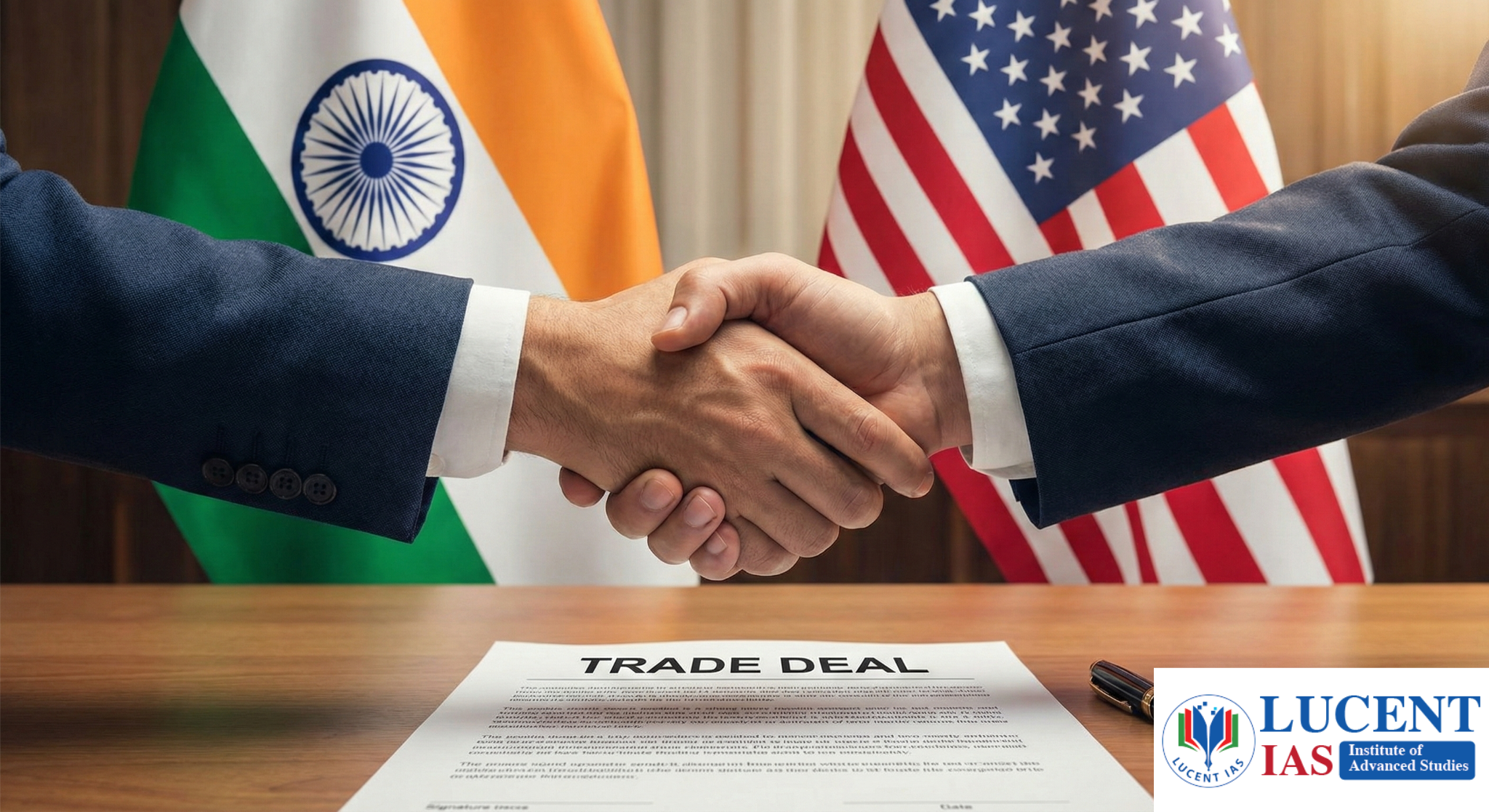
A comprehensive breakdown of the India-US Trade Deal (2025), covering the COMPACT framework, tariff rationalisation to 18%, the TRUST initiative, and key challenges for Civil Services aspirants.Read More Below.
Context: India’s Expanding Trade Architecture
India’s trade strategy is currently operating at scale through a series of strategic agreements. The latest India–US trade deal serves as a major milestone, enhancing market access, certainty, and competitiveness. This is part of a broader “Trade Architecture” India is building globally:
- Europe: FTAs with the EU, UK, and EFTA providing preferential access to the entire region.
- Indo-Pacific: Agreements with Australia and New Zealand.
- West Asia: Trade pacts with UAE and Oman.
- America: This latest deal strengthens access to the massive U.S. market.
Background: Why the Deal Was Needed
The negotiations were driven by rising friction in bilateral economic diplomacy:
- Tariff Threats: The US criticized India’s high tariffs, threatening a 25% reciprocal duty by mid-2025.
- The “Russia” Factor: India’s purchase of Russian oil led to threats of an additional 25% punitive tariff.
Key Feature of the deal
After approximately one year of technical talks and economic diplomacy, the deal achieved a significant breakthrough:
Reduced Duties: U.S. tariffs on Indian goods have been reduced to 18%.
Impact: This is a major relief compared to earlier tariffs that reached as high as 50%, which were hurting Indian exporters.
India–US Trade Snapshot (FY25)
- Bilateral Trade: USD 132 billion (Up from USD 119.71 bn in FY24).
- Trade Surplus: USD 40.82 billion (in India’s favor).
- Key Exports to US: Electrical machinery, gems & jewellery, pharma, machinery, fuels, iron & steel.
- Key Imports from US: Mineral fuels, precious metals, nuclear reactors, machinery, electrical equipment.
- FDI: The US is the 3rd largest investor in India, with USD 70.65 billion invested between 2000–2025.
The COMPACT Framework (2025)
The deal is anchored by the COMPACT framework (Catalysing Opportunities for Military Partnership, Accelerated Commerce & Technology).
1. Trade & Investment (Mission 500)
- Target: Achieve USD 500 billion in bilateral trade by 2030.
- Access: Greater market access for agriculture and industrial goods, with tariff reductions on beverages, vehicles, and ICT products.
2. Defence Cooperation
- New 10-year Major Defence Partnership Framework (2025–2035).
- Enhanced joint exercises, such as Tiger Triumph.
3. Technology & Innovation (iCET to TRUST)
- The Initiative on Critical and Emerging Technology (iCET) has been rebranded as TRUST (Transforming the Relationship Utilizing Strategic Technology).
- Core Principle: India is ready to share core technologies with the US and expects Washington to do the same.
- Focus Areas: Semiconductors, AI, Quantum Computing, Wireless Telecommunication, and critical minerals (lithium, rare earths).
4. Energy & Space
- Energy: Deeper cooperation in oil, gas, and nuclear energy. The US will support India’s International Energy Agency (IEA) membership.
- Space: Enhanced NASA–ISRO collaboration, including the NISAR satellite launch.
Significance of Tariff Rationalisation
For India: Competitiveness
- Export Revival: The cut to 18% restores competitiveness, offering immediate gains for sectors with thin margins like textiles, apparel, and pharmaceuticals.
- Relative Advantage: India (18%) is now better positioned than competitors like Vietnam (20%), Bangladesh (20%), and China (30–35%).
- Stability: Reduces trade-war uncertainty, aiding rupee stability and reviving manufacturing FDI.
For the US: Market Access
- Nuclear & Defence: Entry into India’s nuclear sector via the SHANTI Act (2025) and defence manufacturing.
- Digital Gains: Tax holidays for data centers in India’s Union Budget 2026–27 benefit US tech firms.
- Energy Exports: With India shifting away from Russian oil, a long-term market opens for US oil, LNG, and coal. (India’s crude import dependence reached 88.2% in FY25).
Key Challenges
Strategic & Geopolitical
Strategic Autonomy Risk: Deepening defence ties with the US may strain India’s historical relationship with Russia.
The China Factor: India remains dependent on China for Active Pharmaceutical Ingredient and rare earth minerals. US insistence on “decoupling” may invite Chinese retaliation.
Economic & Sectoral
Inflation & Import Bill (The Oil Cost): A major downside identified is the potential rise in the Current Account Deficit (CAD) and Inflation as the deal implies a shift away from “discounted Russian oil” toward US energy sources.
Non-Tariff Barriers: The SPS (Sanitary and Phytosanitary) norms—strict US health and safety standards—continue to restrict Indian exports in the agriculture and pharmaceutical sectors. These regulations effectively block products even if the tax on them is low.
Digital Conflict (Data Privacy vs. Big Tech):
India’s Stance: Wants Data Localisation (keeping Indian data within India) under the Digital Personal Data Protection Act, 2023.
US Stance: Pushes for the “free flow” of data, which benefits US tech giants.
Way Forward
Energy Diversification: Balance autonomy by pushing for Green Hydrogen and Small Modular Reactors (SMRs) rather than just swapping Russian oil for US gas.
Market Diversification: Fast-track FTAs with the Gulf and East Asia to reduce over-reliance on the West.
Friendshoring & Manufacturing
- Deep Manufacturing: The focus must shift from simple assembly to deep manufacturing to capture higher value in the global supply chain.
- The China Alternative: India must aggressively pitch itself as a stable alternative to China, capitalizing on the global “Friendshoring” trend where companies relocate to politically aligned nations.
Conclusion
The 18% tariff cut provides India with a strategic window of opportunity. India must use this advantage to upgrade its factories and technology under Atmanirbhar Bharat. By shifting from simple assembly to high-quality manufacturing, India can ensure it remains a strong global player, regardless of how the political landscape changes in the future.
LUECNT IAS Mains Practice Question
Q. Assess the significance of India -US Trade deal for India’s export competitiveness, strategic autonomy, and the vision of Atmanirbhar Bharat.( Write in 250 Words) 15
APSC CCE Previous Year Question
Q.What is the recent India-US ‘TRUST’ initiative related to?
(A) It is a bilateral initiative for mutual cooperation in recovery and processing of critical minerals.
(B) It is a bilateral initiative to ease certain import-export regulations between the two countries.
(C) It refers to a bilateral initiative for transfer of technology for boosting the power sector.
(D) None of the above
Correct Answer: A
Explained: The India–US TRUST initiative focuses on cooperation in critical minerals, including exploration, recovery, processing and supply-chain strengthening. This supports India’s clean-energy transition and reduces dependence on single-source imports.
About Lucent IAS
Lucent IAS is a premier coaching institute in Guwahati, dedicated to empowering APSC aspirants with a result-oriented approach. Recognized as a top destination for APSC Coaching, we offer comprehensive guidance ranging from Foundation Courses and Advanced Mains preparation to our signature Assam-Centric study modules. With expert faculty, small batch sizes for personalized mentoring, and the acclaimed Saadhana Test Series, Lucent IAS is committed to helping you crack the Civil Services Examination.
Publications From LUCENT IAS
- “The Assam Odyssey: The Complete Assam Centric Resource useful for APSC CCE and various other Departmental Examinations. Read More
- InExam PYQ Explained.Read More
- Mains Tattva: The Craft of Answer Writing (GS Paper PYQs). Read More
- Maanchitra – An Illustrative Colour-Coded Informative Map of Assam. Read More
- প্ৰাৰম্ভ (Prarambha). Read More
- অসম ওডিচী – The Assam Odyssey (Assamese Edition). Read More
Start your journey to success today. Visit us at lucentias.com or call +91-6913007777 for more details.