

Explore India’s monument conservation framework, including constitutional provisions, the Archaeological Survey of India, modern technologies, and UNESCO-linked tangible and intangible heritage-essential for APSC and UPSC ( Prelims & Mains )
Blog Source: PIB
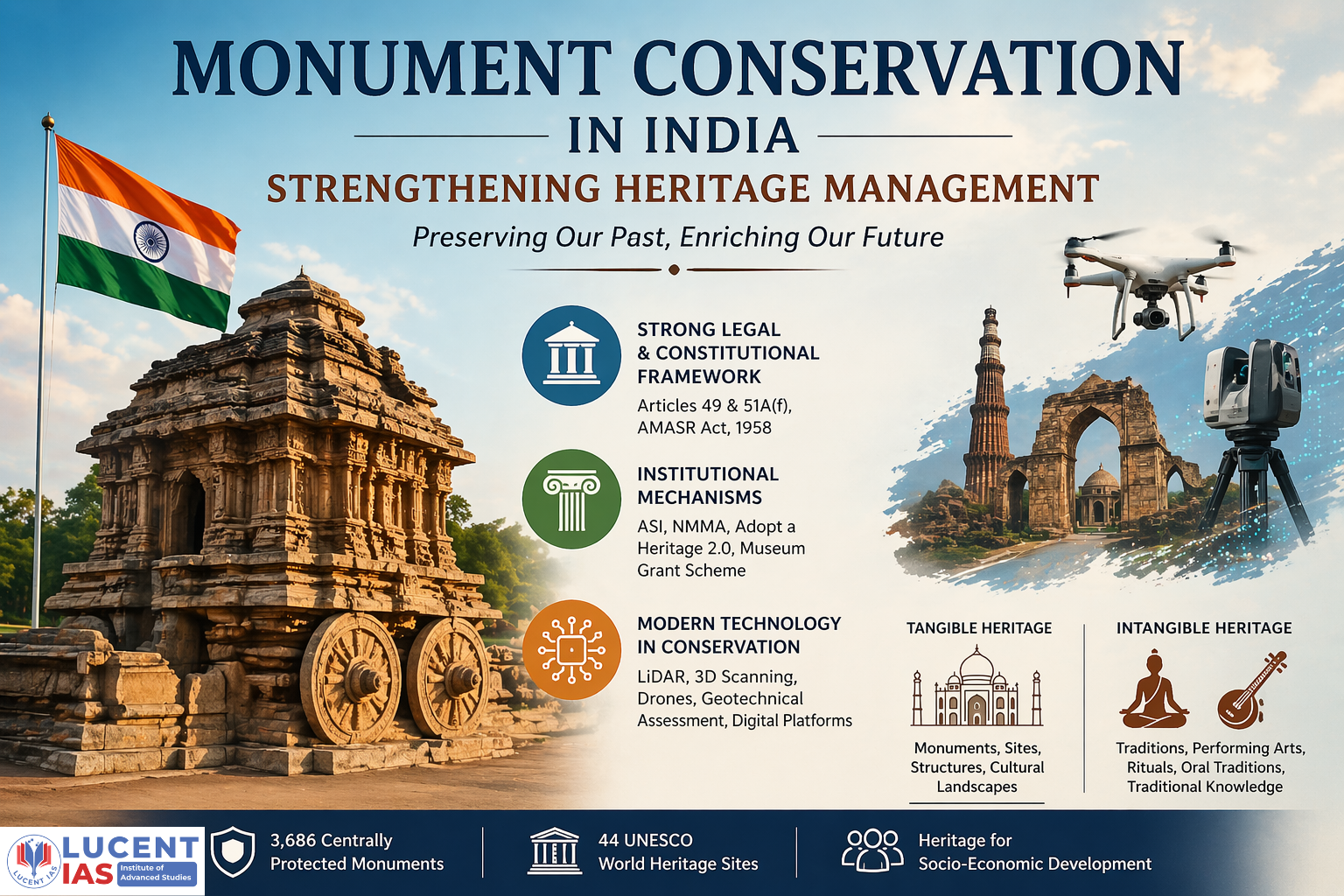
India’s cultural legacy is safeguarded through a comprehensive system that blends constitutional mandates, legislative safeguards, and modern technology. With 3,686 centrally protected monuments and 44 UNESCO World Heritage Sites-including the recent addition of the Maratha Military Landscapes-India now treats heritage as a driver of socio-economic development.
Legislative & Constitutional Framework
- Constitutional Mandate:
- Article 49: Directs the State to protect monuments of national importance.
- Article 51A(f): Establishes the fundamental duty of citizens to preserve the nation’s composite culture.
- Division of Responsibility (7th Schedule):
- Union List (Entry 67): Central Government manages monuments of national importance (via ASI).
- State List (Entry 12): State Governments manage all other local historical sites.
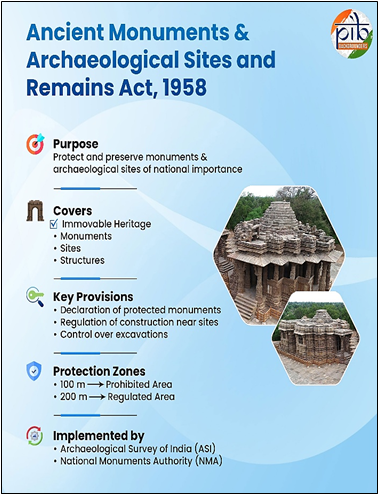
- Ancient Monuments and Archaeological Sites and Remains Act (AMASR), 1958: The primary law empowering the Archaeological Survey of India (ASI) to regulate construction around monuments and ensure their preservation.
Institutional Framework & Initiatives
- Archaeological Survey of India (ASI): Established in 1861; conducts structural/chemical conservation and archaeological research.
- National Mission on Monuments and Antiquities (NMMA): Focuses on creating a national database; has documented over 12.48 lakh antiquities.
- Adopt a Heritage 2.0: A public-private partnership (PPP) model where “Monument Mitras” (private entities) provide visitor amenities (cleanliness, signage) while ASI retains exclusive rights over conservation.
- Museum Grant Scheme: Supports the modernization and digitization of museums to enhance the preservation of artifacts.
Modern Technology in Conservation
The integration of scientific tools has revolutionized how India documents and restores its past:
- LiDAR & 3D Scanning: For high-precision mapping of complex structures.
- Photogrammetry & Drones: Used for aerial mapping and monitoring inaccessible structural changes.
- Geotechnical Assessment: Collaborative efforts (e.g., ASI and IIT Chennai at Kedarnath Temple post-2013) use geophysical testing to ensure foundation stability.
- Indian Culture Portal: A digital platform offering 360-degree virtual tours of sites like the Qutubh Minar to enhance public accessibility.
Tangible and Intangible Cultural Heritage
India’s heritage is broadly classified into tangible and intangible forms, as recognized by UNESCO.
Tangible Cultural Heritage
- Includes monuments, sites, and cultural landscapes of “outstanding universal value.”
- Examples:
- Taj Mahal
- Sanchi Stupa
- Protected under the AMASR Act, 1958.
Intangible Cultural Heritage (ICH)
- Encompasses living traditions, practices, and expressions.
- Includes:
- Yoga
- Vedic Chanting
- Buddhist Chanting of Ladakh
- Safeguarded under the UNESCO Convention for the Safeguarding of Intangible Cultural Heritage, 2003.
- Supported by constitutional provisions like Article 29.
Conclusion
India’s approach to monument conservation reflects a shift from passive preservation to active heritage management. By integrating legal frameworks, institutional mechanisms, and modern technology, the country is not only protecting its past but also leveraging it for sustainable development.
UPSC /APSC Mains Practice Question
1.“India’s approach to monument conservation has evolved from mere preservation to integrated heritage management.” Discuss in the context of constitutional provisions, institutional mechanisms, and the use of modern technology. (Write in 250 Words) 15
2. Distinguish between tangible and intangible cultural heritage. Examine the role of legal and institutional frameworks in safeguarding both in India. (Write in 150 Words) 10
UPSC /APSC Prelims Practice Question
Q. Consider the following statements regarding monument conservation in India:
- Article 49 of the Constitution directs the State to protect monuments of national importance.
- The Archaeological Survey of India was established after Independence.
- The AMASR Act, 1958 regulates construction activities around protected monuments.
Which of the statements given above is/are correct?
(a) 1 and 3 only
(b) 2 only
(c) 1, 2 and 3
(d) 1 only
Correct Answer: A
Explanation: ASI was established in 1861 (pre-independence), so statement 2 is incorrect.
About Lucent IAS
Lucent IAS is a premier coaching institute in Guwahati, dedicated to empowering APSC aspirants with a result-oriented approach. Recognized as a top destination for APSC Coaching, we offer comprehensive guidance ranging from Foundation Courses and Advanced Mains preparation to our signature Assam-Centric study modules. With expert faculty, small batch sizes for personalized mentoring, and the acclaimed Saadhana Test Series, Lucent IAS is committed to helping you crack the Civil Services Examination.
Publications From LUCENT IAS
- “The Assam Odyssey: The Complete Assam Centric Resource useful for APSC CCE and various other Departmental Examinations. Read More
- InExam PYQ Explained.Read More
- Mains Tattva: The Craft of Answer Writing (GS Paper PYQs). Read More
- Maanchitra – An Illustrative Colour-Coded Informative Map of Assam. Read More
- প্ৰাৰম্ভ (Prarambha). Read More
- অসম ওডিচী – The Assam Odyssey (Assamese Edition). Read More
Start your journey to success today. Visit us at lucentias.com or call +91-6913007777 for more details.