

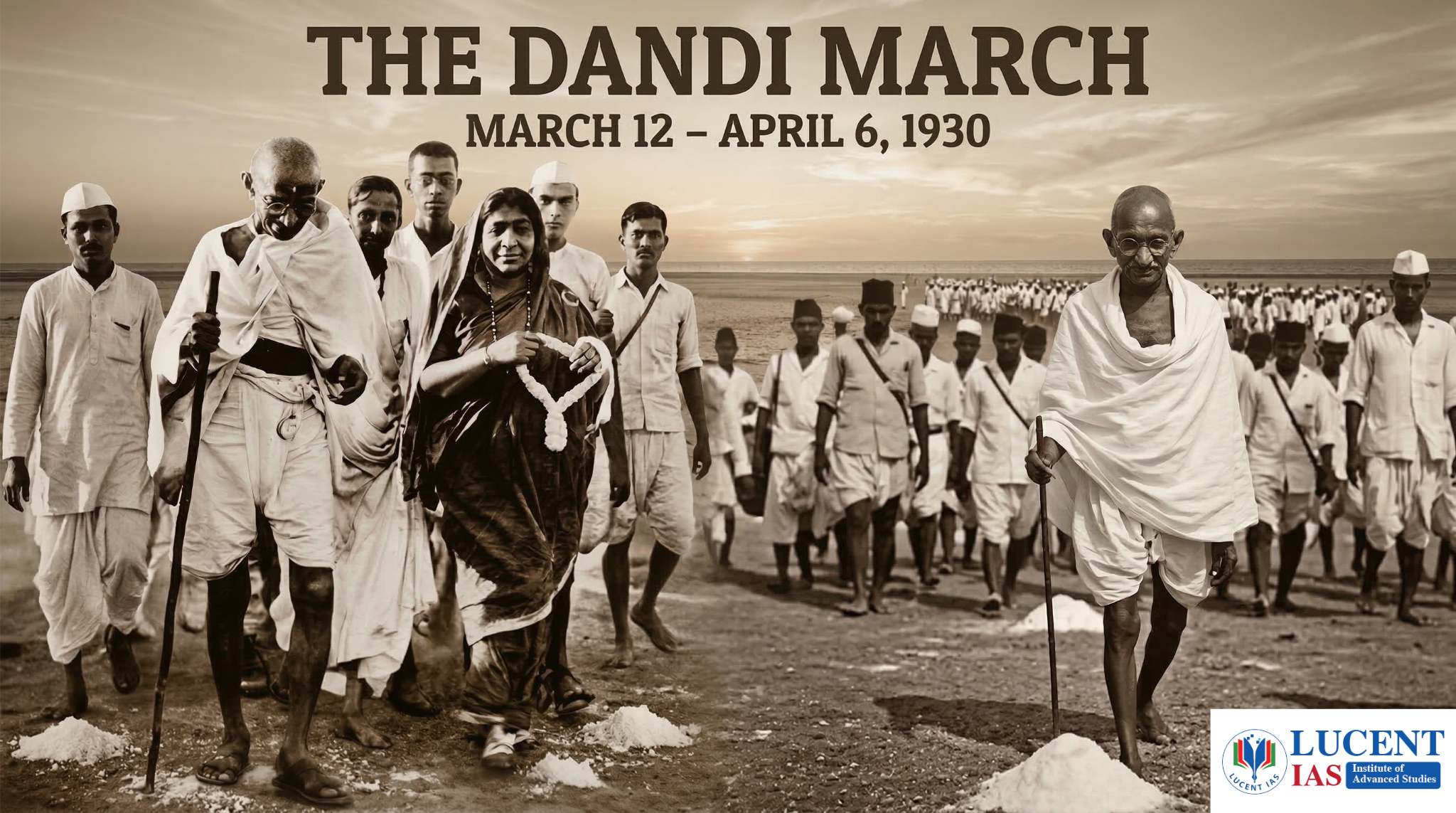
96 Years of Dandi March : revisit how Mahatma Gandhi led a peaceful protest against the British salt tax, inspiring millions and transforming India’s freedom struggle into a powerful mass movement. Important for APSC & UPSC(Prelims & Mains). Read more below.
Civil Disobedience Movement
- After the Lahore Congress of 1929 declared the goal of Purna Swaraj (complete independence), the responsibility of deciding the method of struggle was left to Mahatma Gandhi.
- It was decided that a nationwide non-violent movement would begin, and 26 January 1930 was observed as Independence Day to prepare people for mass civil disobedience.
Gandhi’s Efforts Before the Movement
- Before launching the movement, Gandhi tried to reach a compromise with the British government. He placed a set of demands, hoping that if they were accepted, agitation could be avoided.
- These demands included reducing the rupee-sterling exchange rate, lowering land revenue, abolishing the salt tax and government monopoly over salt, cutting military expenditure and high salaries of officials, protecting Indian industries like textiles and coastal shipping, and releasing political prisoners.
- Many leaders, including Jawaharlal Nehru, felt these demands were moderate compared to the demand for complete independence.
- The government, however, rejected the proposals. Gandhi then informed the Viceroy that he would begin civil disobedience, especially against the salt laws, which he believed affected the poorest people the most.
Beginning of the Movement
Gandhi formally started the movement with the historic Dandi March on 12 March 1930.
Key facts About Dandi March
- Also called Salt Satyagraha
- Duration: 12 March 1930- 6 April 1930.
- Protest against the British salt monopoly and salt tax.
- Began from Sabarmati Ashram with 78 followers.
- Covered 241 miles to Dandi on the Arabian Sea coast.
- Liladhar Baruah from Assam participated in Mahatma Gandhi’s historic Dandi March in 1930.
Spread of the Movement
- The movement quickly spread to different parts of India. Boycotts of officials and institutions increased, and many people joined protests despite harsh repression by the British authorities.
- Reports of police brutality created sympathy among villagers and encouraged wider participation.
- At the same time, some events occurred outside Gandhi’s strictly non-violent framework. Revolutionary actions like the Chittagong Armoury Raid in Bengal, protests in Peshawar following the arrest of Khan Abdul Ghaffar Khan, and labour unrest in Sholapur showed the intensity of public anger.
- When the monsoon made salt production difficult, the Congress encouraged other forms of protest such as refusal to pay land revenue, forest law violations, and no-rent campaigns.
- In many areas, peasants and tribal communities took an active part, sometimes clashing with authorities.
Response of Different Sections
- The response to the Civil Disobedience Movement varied among different social groups. Urban middle-class participation was somewhat less visible than during the Non-Cooperation Movement.
- However, merchants, traders, and some industrialists supported the movement, especially through the boycott of foreign goods, which led to a sharp fall in British cloth imports.
- A remarkable feature of this movement was the large-scale participation of women.
- Women from different social backgrounds joined picketing, demonstrations, and even faced arrests. Their involvement gave the movement a new social dimension and increased its moral strength.
Major Developments
- In Bombay and Karachi, large crowds made salt.
- Over 60,000 people arrested; Gandhi arrested on 5 May 1930.
- On 21 May, Sarojini Naidu led 2,500 protesters at Dharasana Salt Works.
- American journalist Webb Miller reported the event, creating international outrage.
- In Manipur, Rani Gaidinliu responded to the call of Gandhi. She was captured in 1932 and sentenced to life imprisonment. ( Nehru gave her the title Rani).
Assessment of the Movement
- The Civil Disobedience Movement was a landmark phase of India’s freedom struggle, marked by both significant achievements and clear limitations.
- It began with Mahatma Gandhi’s historic Salt March, which captured the imagination of the nation and drew thousands of people into the movement.
- Gandhi’s message of swaraj and peaceful resistance encouraged mass participation, and the Congress broadened its demands so that different sections of society could identify with the struggle.
- Many industrialists also extended support, as several of the demands had an economic dimension that aligned with their interests.
- However, the movement did not achieve equal enthusiasm across all sections of society.
Criticism
- The idea of swaraj remained abstract for some groups, and participation from the intelligentsia, labourers, and many peasants was limited in several regions.
- The depressed classes (Dalits) often felt that their social concerns were not adequately addressed, and Muslim participation remained uneven, except in areas like the North-West Frontier Province under Khan Abdul Ghaffar Khan.
- Some young leaders, including Jawaharlal Nehru and Subhas Chandra Bose, were disappointed by the withdrawal of the movement, feeling that the struggle for complete independence had lost momentum.
- Peasants in certain regions were also dissatisfied, especially where their immediate grievances were not resolved.
- Another major criticism arose from the Gandhi–Irwin Pact and the suspension of the movement, which some historians believe reflected pressure from business interests that were unsettled by prolonged mass agitation and economic disruption caused by boycotts and the global depression.
- Industrial support, though present, was often cautious rather than wholehearted.
- Thus, while the Civil Disobedience Movement succeeded in mobilizing large sections of the population and strengthening the nationalist cause, it also revealed social divisions, uneven participation, and the practical challenges of sustaining a nationwide mass struggle.
UPSC Previous Year Question
UPSC CSE 2025 Prelims
Q. “Sedition has become my religion” was the famous statement given by Gandhiji at the time of
(a) The Champaran Satyagraha
(b) Publicly violating Salt Law at Dandi
(c) Attending the Second Round Table Conference in London
(d) The launch of the Quit India Movement
Correct Answer: B
Explanation: During the Salt Satyagraha in 1930, Mahatma Gandhi famously declared that “sedition has become my religion.” By breaking the Salt Law at Dandi, he meant that resisting unjust British laws had become his moral duty and a central part of India’s struggle for freedom.
About Lucent IAS
Lucent IAS is a premier coaching institute in Guwahati, dedicated to empowering APSC aspirants with a result-oriented approach. Recognized as a top destination for APSC Coaching, we offer comprehensive guidance ranging from Foundation Courses and Advanced Mains preparation to our signature Assam-Centric study modules. With expert faculty, small batch sizes for personalized mentoring, and the acclaimed Saadhana Test Series, Lucent IAS is committed to helping you crack the Civil Services Examination.
Publications From LUCENT IAS
- “The Assam Odyssey: The Complete Assam Centric Resource useful for APSC CCE and various other Departmental Examinations. Read More
- InExam PYQ Explained.Read More
- Mains Tattva: The Craft of Answer Writing (GS Paper PYQs). Read More
- Maanchitra – An Illustrative Colour-Coded Informative Map of Assam. Read More
- প্ৰাৰম্ভ (Prarambha). Read More
- অসম ওডিচী – The Assam Odyssey (Assamese Edition). Read More
Start your journey to success today. Visit us at lucentias.com or call +91-6913007777 for more details.