

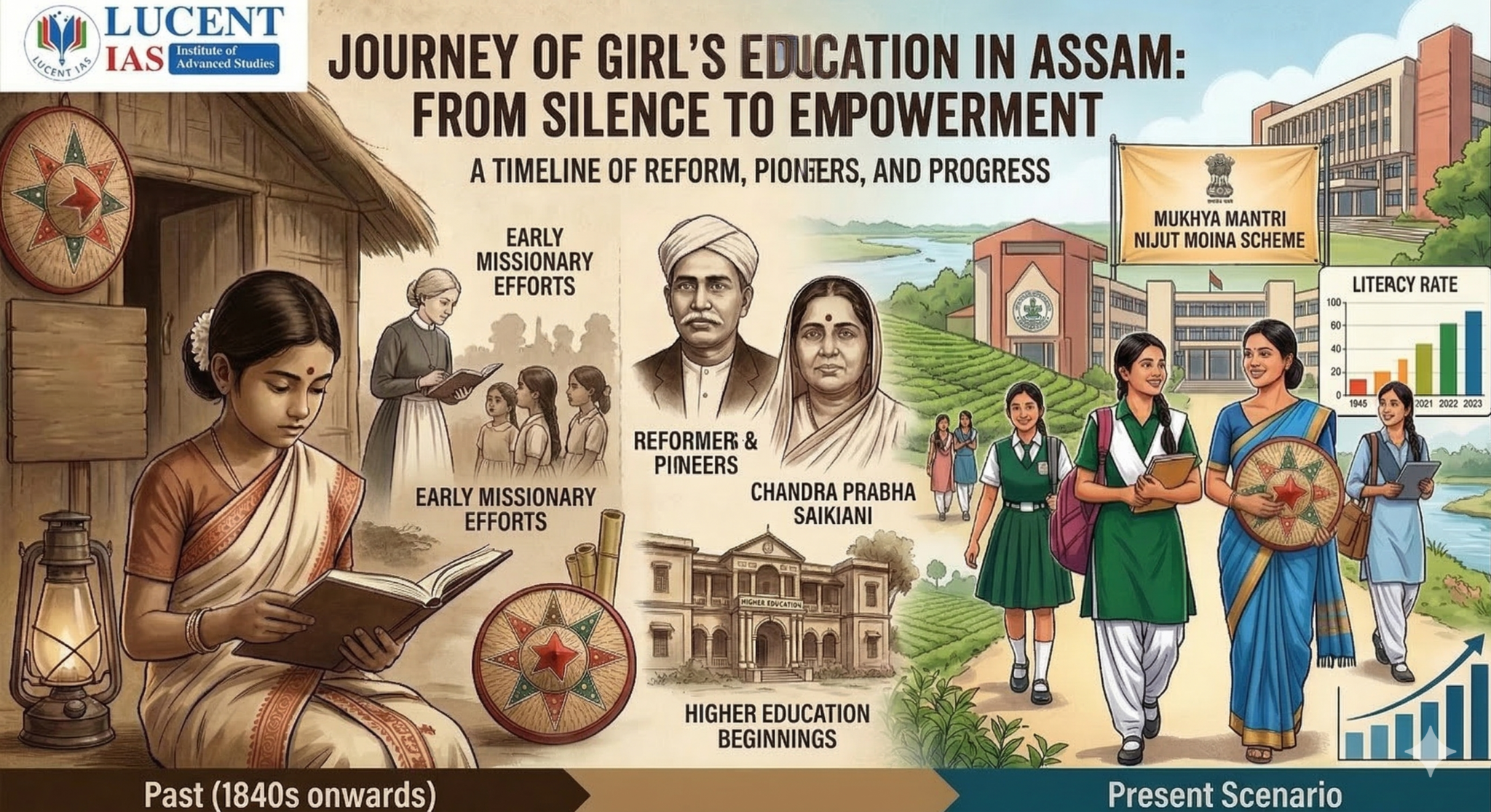
Explore the transformative history and current challenges of Girl’s Education in Assam . From 19th-century pioneers to modern government initiatives like the Nijut Moina scheme, understand the journey of women’s empowerment in the region. Important for APSC( Prelims& Mains).Read More Below.
Early Challenges in Girls’ Education in Assam (1840s onwards)
Societal Norms
- During the 1840s, educating girls was widely considered unnecessary.
- Women were expected to perform domestic duties and marry early.
- Early marriage significantly limited opportunities for girls to attend school.
Missionary Initiatives
Christian missionaries were the first to promote girls’ education in Assam.
- 1839: Mrs. Oliver T Cutter opened the first girls’ school in Sadiya.
- 1840: Missionary Miles Bronson started a girls’ school in Sivasagar.
- Later, girls’ schools were established in Guwahati (Chatribari), Jorhat, and Golaghat.
Missionary Strategy
Zenana Education
To overcome social barriers, missionaries introduced Zenana education, a home-based teaching system where female teachers visited households to teach girls basic literacy and skills.
Hunter Commission Observation (1882)
The Hunter Commission reported extremely low female education in Assam:
- Only 1 in 2,236 girls attended school in Assam.
- In comparison, 1 in 403 girls attended school in the Madras Presidency.
- British observers also noted that Assamese women were “denied even the mental portion of education.”
Reformers and Institutions Promoting Girls’ Education
Key Reformers
Anandaram Dhekial Phukan
- One of the earliest advocates of female education in Assam.
- He personally educated his daughter Padmavati at home.
Gunabhiram Barua
- Strong supporter of women’s education.
- Used the Assamese journal Orunodoi to criticize gender discrimination in education.
- Sent his daughter Swarnalata Barua to Bethune School in Calcutta, making her the first Assamese girl to study there.
Important institutions
- Missionary girls’ schools in Sivasagar, Guwahati, Golaghat, and Jorhat.
- St. Mary’s Convent School established by Catholic nuns.
- Baptist Girls’ School, Silchar (1895).
- Dinanath Nabakishore Girls’ School (1921).
Teachers in these institutions were mostly Assamese women with limited education, along with some Burmese and tribal converts trained by missionaries.
Later Developments in Women’s Education
First Women Graduates of Assam
- Sudhalata Duara
- Sukhalata Duara
They became the first female graduates from Assam, marking an important milestone.
Role of Women Reformers
Chandra Prabha Saikiani (1901)
- A pioneering teacher and social reformer.
- Actively opposed child marriage and promoted women’s education and empowerment.
Rajabala Das (1892–1985)
- First Assamese woman to obtain an MA degree.
- Co-founded Handique Girls’ College, Guwahati (1939).
Swarnalata Barua
- Educated at Bethune School.
- Became a prominent writer and intellectual in Assamese society.
Situation before Independence
Before the 1930s, higher educational institutions such as Cotton College had very few female students. However, the establishment of girls’ schools and colleges gradually increased women’s participation in education.
Contemporary Landscape: Challenges and Progress
| Metric/Focus Area | Status/Observation |
| Female Literacy | Approximately 66.27%–67.3% |
| Primary Enrollment | Relatively high; positive retention |
| Secondary Transition | Notable dropout increase (Key hurdle) |
| Regional Disparity | High dropout rates in tea garden communities |
Government Initiatives
- Mukhya Mantrir Nijut Moina Scheme: Financial stipend for girls from Class XI to Post-Graduation to reduce dropout rates.
- Samagra Shiksha Axom.
Practice Questions for Civil Services Examination
APSC Mains Practice Question
Q. Discuss the evolution of girls’ education in Assam from the 19th century to the present. Highlight the role of missionaries, social reformers, and government initiatives in promoting women’s education in the state.(Write in 250 Words) 15
APSC Prelims Practice Question
Q. Consider the following statements regarding the development of girls’ education in Assam:
- The first girls’ school in Assam was opened at Sadiya by Mrs. Cutter in 1839.
- Gunabhiram Barua sent his daughter Swarnalata Barua to Bethune School in Calcutta.
- Rajabala Das was the first Assamese woman to graduate with an MA degree.
- The Hunter Commission reported that female education in Assam was higher than in the Madras Presidency.
Which of the statements given above are correct?
A. 1 and 2 only
B. 1, 2 and 3 only
C. 2, 3 and 4 only
D. 1, 3 and 4 only
Correct Answer: B
Explained: Statement 4 is incorrect because, Hunter Commission reported female education in Assam was far lower than Madras Presidency.
About Lucent IAS
Lucent IAS is a premier coaching institute in Guwahati, dedicated to empowering APSC aspirants with a result-oriented approach. Recognized as a top destination for APSC Coaching, we offer comprehensive guidance ranging from Foundation Courses and Advanced Mains preparation to our signature Assam-Centric study modules. With expert faculty, small batch sizes for personalized mentoring, and the acclaimed Saadhana Test Series, Lucent IAS is committed to helping you crack the Civil Services Examination.
Publications From LUCENT IAS
- “The Assam Odyssey: The Complete Assam Centric Resource useful for APSC CCE and various other Departmental Examinations. Read More
- InExam PYQ Explained.Read More
- Mains Tattva: The Craft of Answer Writing (GS Paper PYQs). Read More
- Maanchitra – An Illustrative Colour-Coded Informative Map of Assam. Read More
- প্ৰাৰম্ভ (Prarambha). Read More
- অসম ওডিচী – The Assam Odyssey (Assamese Edition). Read More
Start your journey to success today. Visit us at lucentias.com or call +91-6913007777 for more details.