

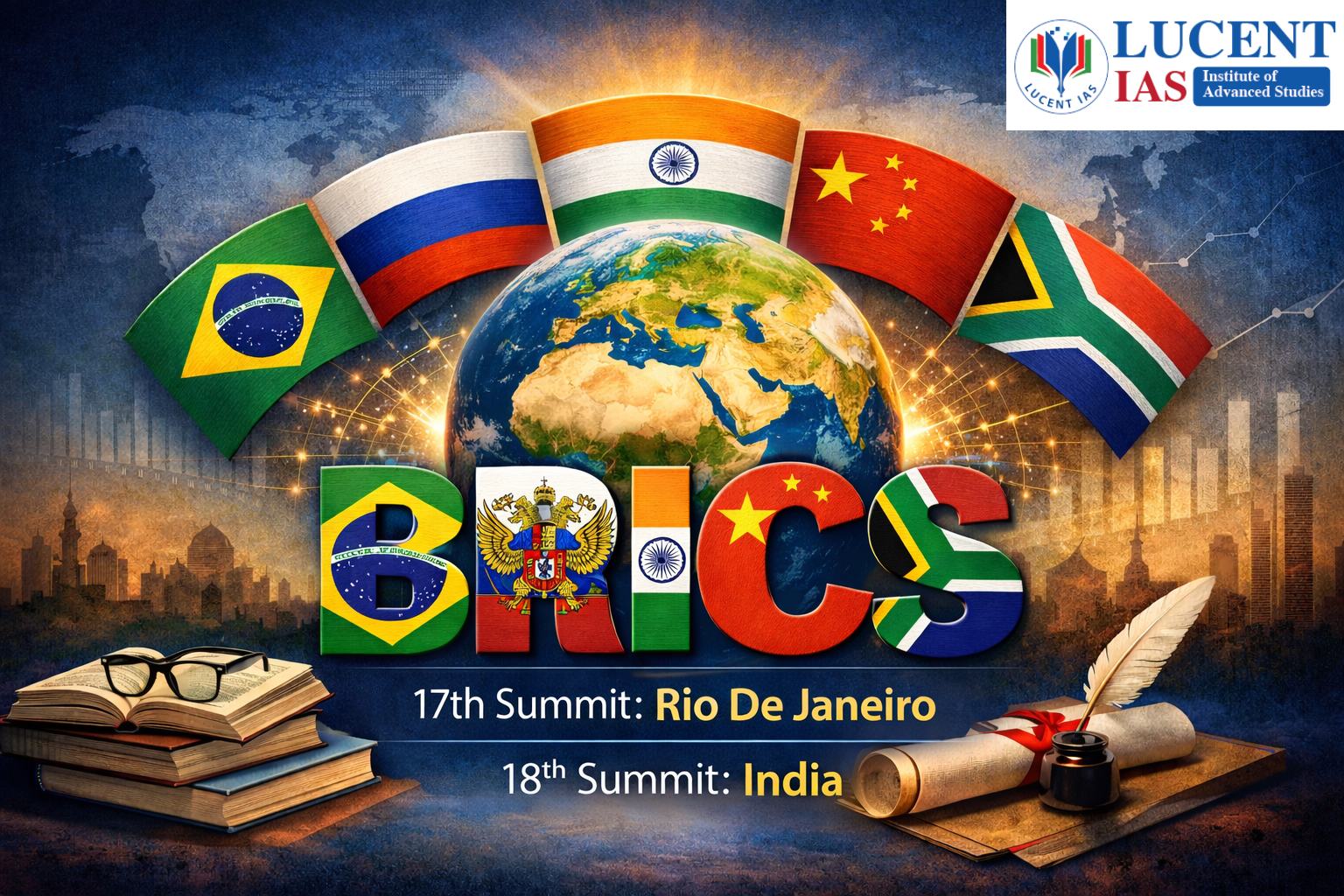
BRICS is a major grouping of emerging economies representing the Global South. Learn about its origin, objectives, members, partner countries, key initiatives, and highlights of the 17th BRICS Summit relevant for APSC and UPSC ( Prelims and Mains).
What is BRICS?
BRICS is a grouping of eleven major emerging economies—Brazil, Russia, India, China, South Africa, Egypt, Ethiopia, Iran, Saudi Arabia, the United Arab Emirates, and Indonesia. It serves as a political, economic, and diplomatic coordination forum, mainly representing countries of the Global South.
History and Origins of BRICS
The term “BRIC” was first coined in 2001 by an economist at Goldman Sachs to describe the rapidly growing economies of Brazil, Russia, India, and China. Over time, this concept evolved into a political and diplomatic platform through the initiative of the governments of these countries.
The first meeting of BRIC foreign ministers was held in 2006 on the sidelines of the United Nations General Assembly in New York, and the first summit of leaders took place in 2009 in Ekaterinburg, Russia.
Following the 2008 global financial crisis, these countries began coordinating more closely within institutions such as the G20, IMF, and World Bank, often pushing for reforms in global financial governance to reflect the growing role of emerging economies.
In 2011, South Africa joined, and the grouping became BRICS. A major expansion was announced at the Johannesburg Summit in 2023, and between 2024 and 2025, Egypt, Ethiopia, Iran, Saudi Arabia, the UAE, and Indonesia were admitted, increasing the total membership to eleven countries.
Objectives of BRICS
The major objectives of BRICS include:
- Strengthening economic, political, and social cooperation among member states.
- Enhancing the voice of developing countries in global decision-making.
- Promoting reforms in international financial and political institutions.
- Encouraging sustainable development and social inclusion.
- Expanding South–South cooperation in areas such as trade, health, technology, and education.
Member Countries of BRICS
At present, BRICS consists of eleven countries:
- Brazil
- Russia
- India
- China
- South Africa
- Egypt
- Ethiopia
- Iran
- Saudi Arabia
- United Arab Emirates
- Indonesia
BRICS Partner Countries
To broaden cooperation, BRICS introduced a “partner country” category. These countries participate in selected initiatives and dialogues without being full members.
Partner countries include:
- Belarus
- Bolivia
- Cuba
- Kazakhstan
- Malaysia
- Nigeria
- Thailand
- Uganda
- Uzbekistan
- Vietnam
Vietnam’s inclusion is particularly notable due to its large population, strong economic growth, and active role in global value chains, as well as its commitment to South–South cooperation and sustainable development.
17th BRICS Summit: Key Highlights
The 17th BRICS Summit was held in Rio de Janeiro, Brazil, under the theme “Strengthening Global South Cooperation for More Inclusive and Sustainable Governance.”
Key outcomes of the summit included:
- Adoption of the Rio de Janeiro Declaration, reaffirming cooperation among developing nations.
- Indonesia formally joined BRICS as a full member.
- Several countries were welcomed as partner countries, reflecting the growing global relevance of the grouping.
- Launch of the Partnership for the Elimination of Socially Determined Diseases, with a focus on tackling tuberculosis and reducing health inequalities.
- Announcement that India will assume the BRICS Chairship and host the 18th BRICS Summit in 2026.
UPSC Prelims PYQ
UPSC CSE 2025
Consider the following statements with regard to BRICS:
I. 16th BRICS Summit was held under the Chairship of Russia in Kazan.
II. Indonesia has become a full member of BRICS.
III. The theme of the 16th BRICS Summit was Strengthening Multiculturalism for Just Global Development and Security.
Which of the statements given above is/are correct?
(a) I and II
(b) II and III
(c) I and III
(d) I only
Correct Answer: a
Explanation: The theme of the 16th BRICS Summit is “Strengthening Multilateralism for Just Global Development and Security.”
UPSC CSE 2014
Q.With reference to a grouping of countries known as BRICS, consider the following statements:
- The First Summit of BRICS was held in Rio de Janeiro in 2009.
- South Africa was the last to join the BRICS grouping.
Which of the statements given above is/are correct?
(a) 1 only
(b) 2 only
(c) Both 1 and 2
(d) Neither 1 nor 2
Correct Answer: b
Explanation: The first BRIC Summit (before South Africa joined) was held in Yekaterinburg, Russia, in 2009 — not in Rio de Janeiro, Brazil.
About Lucent IAS
Lucent IAS is a premier coaching institute in Guwahati, dedicated to empowering APSC aspirants with a result-oriented approach. Recognized as a top destination for APSC Coaching, we offer comprehensive guidance ranging from Foundation Courses and Advanced Mains preparation to our signature Assam-Centric study modules. With expert faculty, small batch sizes for personalized mentoring, and the acclaimed Saadhana Test Series, Lucent IAS is committed to helping you crack the Civil Services Examination.
Publications From LUCENT IAS
- “The Assam Odyssey: The Complete Assam Centric Resource useful for APSC CCE and various other Departmental Examinations. Read More
- InExam PYQ Explained.Read More
- Mains Tattva: The Craft of Answer Writing (GS Paper PYQs). Read More
- Maanchitra – An Illustrative Colour-Coded Informative Map of Assam. Read More
- প্ৰাৰম্ভ (Prarambha). Read More
- অসম ওডিচী – The Assam Odyssey (Assamese Edition). Read More
Start your journey to success today. Visit us at lucentias.com or call +91-6913007777 for more details.